


Mantle cell lymphoma
Choose a type
On this page
-
What is mantle cell lymphoma?
-
Symptoms of mantle cell lymphoma
-
Causes of mantle cell lymphoma
-
Diagnosis of mantle cell lymphoma
-
The stages and grades of mantle cell lymphoma
-
Treatment for mantle cell lymphoma
-
After treatment for mantle cell lymphoma
-
Support for people with mantle cell lymphoma
-
Access our lymphoma information in other formats
-
About our information
-
How we can help
What is mantle cell lymphoma?
Mantle cell lymphoma (MCL) is a rare type of non-Hodgkin lymphoma (NHL). MCL develops when B-cells become abnormal (cancerous). B-cells are white blood cells that normally help fight infection. They are sometimes called B-lymphocytes.
The abnormal B-cells (lymphoma cells) usually build up in lymph nodes, but they can affect other parts of the body.
Related pages
For healthcare professionals
If you are a healthcare professional, use our guide to find the right information and support for your patients affected by lymphoma. This explains the support available from Macmillan and from other trusted organisations.
Symptoms of mantle cell lymphoma
Painless swelling in the neck, armpit or groin
Some people do not have any symptoms, but a painless swelling in the neck, armpit or groin is the most common sign of MCL. It is caused by lymphoma cells building up in the lymph nodes, which makes them bigger.
Other symptoms
Sometimes MCL can affect other areas of the body. These can include the spleen, bowel and bone marrow.
Depending on where the lymphoma spreads to, this can cause symptoms such as:
- loss of appetite
- diarrhoea
- sickness (nausea)
- a full feeling in the tummy – this is caused by an enlarged spleen
- anaemia – this is caused by the low number of red blood cells in your blood.
Related pages
Causes of mantle cell lymphoma
The causes of mantle cell lymphoma (MCL) are mostly unknown. MCL is most common in people over the age of 70. It is more common in men than women.
Like other cancers, MCL is not infectious. It cannot be passed on to other people.
We have more information about causes and risk factors for non-Hodgkin lymphoma.
Diagnosis of mantle cell lymphoma
Sometimes MCL can be found with a routine blood test. But usually the most common test for diagnosing lymphoma is a biopsy. A doctor will take a sample of tissue from the affected area. The most common place to take a biopsy from is an enlarged lymph node. This is called a lymph node biopsy. You may have all or a part of the lymph node removed. The tissue will be sent to a laboratory for testing.
You may also have biopsies taken from other areas of your body, such as your bowel. This is done during a test called a colonoscopy.
You can read more about the tests you may have in our information about non-Hodgkin lymphoma.
Waiting for test results can be difficult. You may find it helpful to talk to your family, friends or specialist nurse.
Related pages
Booklets and resources

The stages and grades of mantle cell lymphoma
Your test results will help your doctors find out how many areas of your body are affected by lymphoma and where these areas are. This is called staging.
Lymphomas are also grouped as either low-grade or high-grade. Low-grade lymphomas are usually slow growing. High-grade lymphomas usually grow more quickly. Mantle cell lymphoma (MCL) can be either high-grade or low-grade.
Knowing the stage and grade of the lymphoma helps your doctor plan the right treatment for you.
We have more information about the stages and grades of non-Hodgkin lymphoma.
Treatment for mantle cell lymphoma
A team of specialists will meet to discuss the best possible treatment for you. They are called a multidisciplinary team (MDT).
Your doctor, cancer specialist or nurse will explain the different treatments and their side effects to you. They will also talk to you about things to consider when making treatment decisions.
The aim of treatment is to get rid of as much of the lymphoma as possible.
Treatment for mantle cell lymphoma (MCL) may depend on:
- the stage of the lymphoma
- whether it has become active again after previous treatment
- whether you have symptoms that are causing problems.
The most common treatments for MCL include:
-
Immunotherapy and chemotherapy
MCL is often treated with a combination of the immunotherapy drug rituximab and chemotherapy. This is called chemoimmunotherapy. If the MCL responds well to rituximab and chemotherapy, you may continue to have regular treatments of rituximab on its own. The aim is to keep the lymphoma in remission. This is called rituximab maintenance. Your doctor can tell you how long maintenance treatment might continue.
Combinations of rituximab and chemotherapy that may be used include rituximab and bendamustine, R-CHOP or rituximab and chlorambucil.
People who are well enough to cope with the side effects of intensive treatments may be given a combination that includes high doses of the chemotherapy drug cytarabine. You may have the following treatments:
- R-DHAP
- R-DHAOx – rituximab, the steroid dexamethasone, high-dose cytarabine (ARA-C), oxaliplatin
- R-Maxi CHOP/H Ara-C – rituximab, cyclophosphamide, doxorubicin (or hydroxydaunorubicin, vincristine (oncovin), the steroid prednisolone, high dose cytarabine (Ara-C).
-
Targeted therapy
The targeted therapy bortezomib may sometimes be used as the first treatment for MCL. Ibrutinib is used to treat MCL that has become active again after first treatment. Other targeted therapies that are less commonly used include temsirolimus and lenalidomide.
-
Steroids
Steroids are drugs that are often given with chemotherapy to treat lymphomas. They can help make chemotherapy more effective.
Stem cell transplant
A stem cell transplant is an intensive treatment, so it is not suitable for everyone. Usually for MCL your own stem cells are used (autologous stem cell transplant). -
Radiotherapy
Radiotherapy uses high-energy rays to destroy cancer cells, while doing as little harm as possible to nearby healthy cells. It can be used to treat stage 1 or 2 MCL, or to relieve symptoms such as pain.
MCL usually comes back after treatment. Doctors are trying to find improved ways of treating it and controlling it for longer periods. We have more information about treating lymphoma that has come back.
You may have some treatments as part of a clinical research trial.
After treatment for mantle cell lymphoma
People often have many different feelings when they finish lymphoma treatment. You may feel relieved that treatment has finished, but worried about what will happen in the future.
You will have appointments with your lymphoma doctor or nurse less often than before. But at the same time, you may have new challenges to cope with and things to think about.
We have information below about some of the things people ask about after lymphoma treatment. But you may have other questions or need information about something else. If there is something you want to talk about at any point after treatment, you can:
- call the Macmillan Support Line free on 0808 808 00 00
- chat to our specialists online
- visit our Online Community to talk to people who have been affected by lymphoma, share your experience, and ask an expert your questions.
Related pages
Follow-up after treatment for lymphoma
You will have regular check-ups during and after your treatment. Your cancer doctor or specialist nurse will explain what to expect.
Follow-up appointments are a good time for you to talk to your cancer doctor or specialist nurse about any concerns you have. Tell them as soon as possible if you have any problems or notice new symptoms between appointments. We have more information about follow-up care after lymphoma treatment.
Sometimes side effects may continue or develop months or years after treatment. These are called late effects. We have more information about long-term and late effects of treatment for lymphoma.
Well-being and recovery
It can take time to recover after lymphoma treatment. Some days you may feel better than others.
A healthy lifestyle can help speed up your recovery. Even small lifestyle changes may improve your well-being and long-term health.
Even if you already have a healthy lifestyle, you may choose to make some positive changes after treatment. We have more information on leading a healthy lifestyle after treatment.
Support for people with mantle cell lymphoma
Talk to someone about mantle cell lymphoma
Everyone has their own way of dealing with illness and the different emotions they experience. You may find it helpful to talk things over with family and friends or your doctor or nurse.
Macmillan is also here to support you. If you would like to talk, you can:
- Call the Macmillan Support Line on 0808 808 00 00.
- Chat to our specialists online.
- Visit our Mantle cell lymphoma forum to talk with people who have been affected by Mantle cell lymphoma, share your experience, and ask an expert your questions.
More information and advice
We know cancer can affect you physically, emotionally and financially. We have information and advice about different ways cancer might impact you, such as help with:
Other organisations who offer information and support
- Blood Cancer UK offers support and information to people affected by blood cancers, including lymphoma.
- Lymphoma Action provides high quality information and support for people affected by lymphoma. It provides helpline services and a range of peer support including online support meetings, educational events and webinars. Its website includes TrialsLink, a database of lymphoma clinical trials.
Supporting someone with lymphoma
When someone you know is diagnosed with lymphoma, it can be difficult to know how to support them. You may want information to help you understand what they are going through. Or you may be worried about what to say.
We have information to help with the practical, emotional and financial impacts of supporting someone. You can also talk to us by:
- calling the Macmillan Support Line
- using chat online
- visiting our family and friends forum to talk with people who are supporting someone with cancer, share your experience, and ask an expert your questions.
Booklets and resources

Access our lymphoma information in other formats
We are working to make our website as accessible as possible. We want everyone to be able to use it to find the information they need. We have tips about using settings on your computer or device to help you use our website in our accessibility statement.
We also provide information in a range of languages and formats. If you cannot find the information you are looking for in the format or language you need, email us at cancerinformationteam@macmillan.org.uk
Download our lymphoma booklet
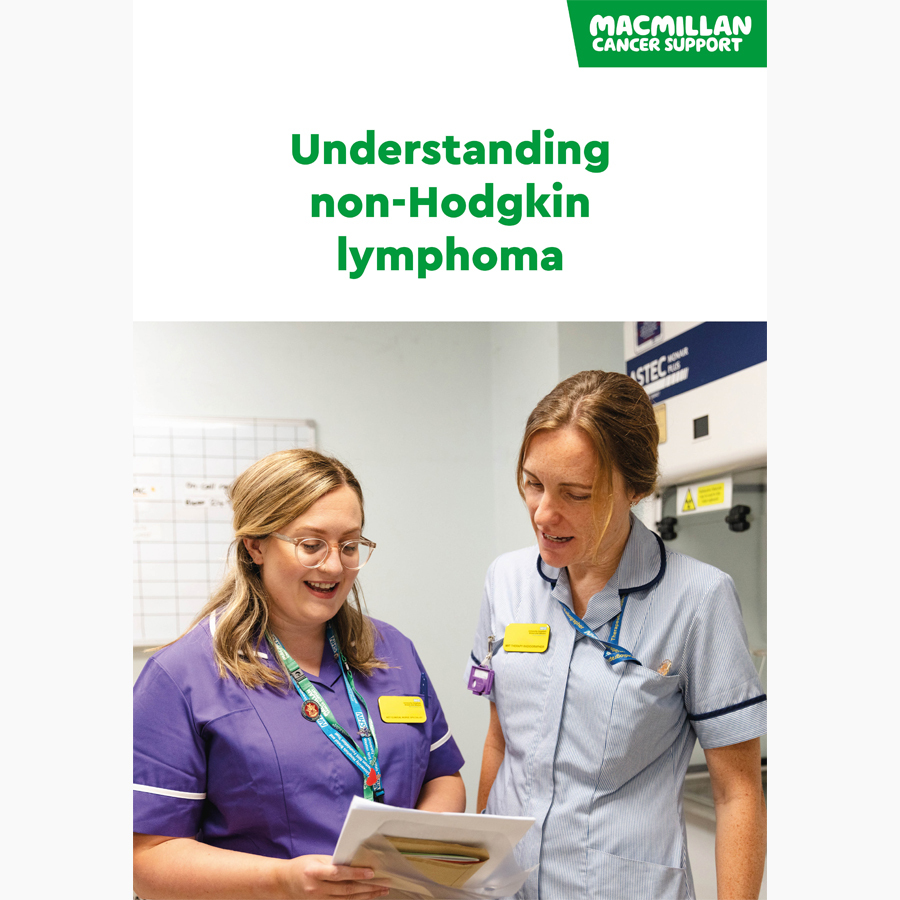
Our Understanding non-Hodgkin lymphoma booklet is available as a pdf to download or view online and in ePub or Mobi formats to download.
Booklets and resources
Find non-Hodgkin lymphoma information in your language
We have a range of translated cancer information. This includes information about different cancer types, being diagnosed, cancer treatment, and side effects. We have some lymphoma information in the following languages. You can also search our most up to date list of web pages we have translated on request.
- Bulgarian - Mantle cell lymphoma / Мантелноклетъчен лимфом [PDF]
- German - Follicular lymphoma / Follikuläres Lymphom (FL) [PDF]
- Polish - Diffuse large B-cell lymphoma (DLBCL) / Chłoniak rozlany z dużych komórek B [PDF]
- Polish - Lymphoma / Chłoniak [PDF]
- Slovak - Anaplastic large cell lymphoma (ALCL) / Anaplastický veľkobunkový lymfóm [PDF]
- Slovak - Follicular lymphoma / Folikulový lymfóm [PDF]
- Tamil - Follicular lymphoma [PDF]
If you would like any of our lymphoma information translated into your language, please email cancerinformationteam@macmillan.org.uk
Watch British sign language videos
You can watch our BSL videos about cancer on YouTube.
Find our easy read booklets
Our easy read booklets use simple words and pictures to tell you about cancer. They can be useful if you want information that is easier to understand.
Looking for large print, Braille or another format?
If you would like our information in a different format such as large print or Braille, email us at cancerinformationteam@macmillan.org.uk or call us free on 0808 808 00 00.
About our information
-
References
Below is a sample of the sources used in our mantle cell lymphoma (MCL) information. If you would like more information about the sources we use, please contact us at cancerinformationteam@macmillan.org.uk
Dreyling M, Geisler C, et al on behalf of the ESMO Guidelines Working Group. Newly diagnosed and relapsed mantle cell lymphoma: ESMO Clinical Practice Guidelines for diagnosis, treatment and follow-up. Annals of Oncology, 2014. 25 (Supplement 3): iii83–iii92. Available from www.annalsofoncology.org/action/showPdf?pii=S0923-7534%2819%2934092-X
McKay P, Leach M, et al. British Committee for Standards in Haematology. Guidelines for the investigation and management of mantle cell lymphoma. British Journal of Haematology. 2012. 159 (4), 405–426.
-
Reviewers
This information has been written, revised and edited by Macmillan Cancer Support’s Cancer Information Development team. It has been reviewed by expert medical and health professionals and people living with cancer. It has been approved by Senior Medical Editor, Dr Anne Parker, Consultant Haematologist.
Our cancer information has been awarded the PIF TICK. Created by the Patient Information Forum, this quality mark shows we meet PIF’s 10 criteria for trustworthy health information.
Date reviewed
This content is currently being reviewed. New information will be coming soon.


Our cancer information meets the PIF TICK quality mark.
This means it is easy to use, up-to-date and based on the latest evidence. Learn more about how we produce our information.