


Help with everyday costs
If you have cancer, you might be facing money worries. Extra costs such as higher household bills and getting to appointments can be harder to pay for.
This information covers some of the most common concerns people have when talking to our money advisers.
You do not have to manage money worries alone. There is support available to help.
Hospital parking and travel fares
Travelling for regular appointments and tests can be expensive, but help is available.
-
Healthcare Travel Costs Scheme
You may be able to get help with the cost of travelling to hospital for planned tests or treatment. This is called The Healthcare Travel Costs Scheme. You may qualify if you get certain benefits or get help through the NHS Low Income Scheme. You usually have to pay first and claim a refund later. Ask your hospital how to claim. It varies by area. You may also be able to claim for someone travelling with you for medical reasons.
-
Patient and community transport
Ask your hospital about their Patient Transport Service. This may offer free transport in some situations. If public transport is difficult, check for voluntary or community transport services. Ask your local council, library or the Community Transport Association.
-
Hospital parking
Hospital parking policies are different across the UK:
- In England, some hospitals offer free or discounted parking with a Blue Badge or for cancer appointments.
- In Scotland and Wales, hospital parking is free.
- In Northern Ireland, parking is free with a Blue Badge or during chemotherapy or radiotherapy. Ask your hospital about other situations.
Ask your GP, cancer team or hospital about other travel schemes, or check our transport and parking information.
Energy costs
If you are worried about paying your energy bills, contact your supplier and find out what help they can offer. For example, they may have a cheaper or alternative payment plan.
If you live in England, Scotland or Wales, you can also be added to the Priority Services Register to help keep your energy supply switched on. If you live in Northern Ireland, you can be added to critical care registers for energy and water suppliers.
Related pages
Help from your energy company
Some energy suppliers have schemes and trust funds to help if you are having difficulty paying your bills. If your energy supplier does not have a trust fund, the British Gas Energy Trust can help.
You can also visit the Auriga Services website. There is advice about support with energy costs on its Ask Bill page.
In Northern Ireland, you can download the list of support schemes on the Utility Regulator website.
Government payments
There are several government payments to help you with energy bills during the winter months. You can find out information and apply for these at:
- gov.uk if you live in England, Scotland or Wales
- nidirect.gov.uk if you live in Northern Ireland.
-
Cold Weather Payment
If you get certain benefits or Support for Mortgage Interest, you may qualify for a Cold Weather Payment when a winter is very cold. If you live in Scotland, you might get a Winter Heating Payment instead.
-
Winter Fuel Payment
In England, Wales and Northern Ireland, you may be able to get a Winter Fuel Payment if you are eligible. If you live in Scotland, you may be eligible for a payment from the Scottish Government.
-
Warm Home Discount Scheme
The Warm Home Discount Scheme is help for people on a low income to heat their homes. Ask your energy supplier about this or visit gov.uk
If you live in a park home, you can apply through the Park Homes Warm Home Discount.
Energy suppliers in Northern Ireland do not offer the Warm Home Discount. You may get financial help under the Affordable Warmth Scheme instead.
-
Fuel Direct Scheme
If you get certain benefits and you are behind (in arrears) with your energy payments, you can ask your energy supplier about the Fuel Direct Scheme. This allows your energy supplier to receive money directly from your benefits to pay off your debt. It should stop any final demands or debt action on your energy account.
-
Prepayment and “pay-as-you-go” energy
If you have a prepayment or pay-as-you-go meter and you are unable to top up your account, you should contact your energy supplier for support. They can offer you temporary credit.
-
Fuel vouchers
You might be able to get a Fuel Bank Foundation voucher if you are struggling to top up your prepayment meter or pay-as-you-go account. You can also contact your local council, food bank or Citizens Advice. They can apply to the Fuel Bank Foundation for you.
Booklets and resources
Help with broadband costs
If you are on certain benefits, you may be able to get a special broadband deal. This is called a social tariff.
You can also visit your local library, which may provide free internet access through public computers or Wi-Fi.
Home adaptations and equipment
Equipment and changes to the house (adaptations) can help make things easier for you and a carer if you have one. This includes specialised furniture, kitchen aids, or changes to the flooring or bathroom of your home if you use a walking aid or wheelchair.
-
Home adaptations
Your GP, cancer doctor or specialist nurse can arrange these. You may be referred to an occupational therapist (OT) or a social worker for an assessment. OTs give information, support and equipment to help with everyday tasks.
Your local council can also assess your home. A home assessment is free. You can also contact your local social services or social work department directly.
You can get general advice and information about all types of equipment from Living Made Easy. You can also hire equipment from the Red Cross to help with mobility and going to the toilet.
The NHS can provide some equipment for free but there may be some things that involve costs to you. This will depend on if you live in a council or housing association property. Your healthcare team or local social services can tell you more.
You may be able to get disability-related benefits or a grant or a loan.
-
Bedding
If you are in hospital, your nurse can arrange a hospital bed for you at home or equipment to make your bed more comfortable, such as a pressure-relieving mattress or cushion. If you are at home, your GP or district nurse can arrange this.
You may also be able to get grants to help with the costs of new bedding.
The Hospital Saturday Fund offers grants for people who have a medical condition or disability and need financial assistance to buy specialised equipment. This includes orthopaedic mattresses and pillows. You cannot apply for this grant yourself. You must apply through a registered charity or member of your healthcare team.
Related pages
Booklets and resources
Days out and hobbies
Planning days out and making time for hobbies can provide a welcome break from cancer and its treatment.
Days out
Planning days out can give you something positive to think about. Spending time with friends and family can help with wellbeing. It is important to plan around your energy levels and how you are feeling.
The following UK charities offer help with the cost of days out for people affected by cancer.
-
4 cancer
4 Cancer organises days out and short breaks for people living with cancer and their families.
-
Something To Look Forward To
Something To Look Forward To offers people with cancer and their families access a variety of free experiences donated by companies and individuals. This includes meals out, theatre tickets and tickets for attractions.
-
The Osborne Trust
The Osborne Trust offers family support and a network that can help locally with respite days for kids whose parent or guardian is living with cancer.
-
Love Po
Love Po offers people who are receiving cancer treatment, or have had treatment in the last 12 months, the opportunity to apply for free days out and experiences.
Hobbies
Making time for activities you enjoy can help you relax, reduce stress and anxiety, and provide a sense of normality.
You can get more information and support from the following organisations.
-
Maggie’s
Maggie’s offers a range of activities and events for people to connect and enjoy time away from treatment.
-
Penny Brohn UK
Penny Brohn UK offers a weekly programme of online sessions including yoga, Pilates, dance and relaxation.
-
Macmillan Cancer Support
Our Wellbeing Hub is a dedicated webpage with advice on eating well, staying active, self-care, complementary therapies and mental wellbeing.
You can also use our postcode search tool to find local cancer support services, including support groups, exercise classes, information centres, financial and benefits advice.
Hair, skin and nail care
Support is available if cancer treatment has affected your skin, nails or hair.
Related pages
Wigs and hair loss
A wig or hairpiece may be an option if you lose your hair due to cancer treatment. But buying one yourself can be expensive.
-
Getting a wig on prescription
In Scotland, Wales and Northern Ireland, you can get a wig free on prescription. In England, some people are eligible for a free wig. Others may need to pay. Check our support with health costs information.
The process to get a wig varies by hospital. Ask your cancer team how it works in your area.
-
Buying a wig
If you are buying a wig yourself, the following information may be helpful:
- Synthetic wigs cost less than human hair wigs – usually £50 to several hundred pounds less. They are light, easy to care for and last 4 to 8 months.
- Wig banks and charities sell donated wigs at a discount or offer free ones – for example, Cancer Hair Care and the Little Princess Trust (under 24s).
- VAT-free wigs may be available. If hair loss is from cancer treatment, you should not have to pay VAT. Check with your supplier first. You cannot claim it back later.
Wigs are not your only option. Find out about headwear and other choices in our coping with hair loss information.
Booklets and resources
Personal care
The following organisations may be able to help if cancer treatments have affected your skin, nails or hair.
-
Cancer Support UK
Cancer Support UK offers free toiletry kits with a range of practical items to help people undergoing cancer treatment.
-
Look Good Feel Better
Look Good Feel Better runs workshops across the UK to help people manage changes to how they look and feel during cancer treatment. Workshop attendees get a free bag of full-size skincare and grooming products.
It also offers HeadWrappers workshops for anyone who has lost or is likely to lose their hair due to cancer treatment. Workshop attendees get a free bag with headwear.
-
Little Lifts
If you are having treatment for breast cancer, you can apply for a free Little Lifts gift box, which contains helpful items handpicked by people who have had chemotherapy or radiotherapy for breast cancer.
You can also contact a No7 Boots Macmillan Beauty Advisor about managing changes to your appearance. They are specially trained to give advice about caring for your skin, nails and hair during cancer treatment.
Booklets and resources

Clothing and daily essentials
You may be able to get interest-free government loans for different things, such as clothes or daily essentials. Or you may be able to get those things for less if buying them yourself. Some local councils also provide grants for school uniforms.
-
Government loans
If you live in:
- England, Scotland or Wales, you can apply for a Budgeting Loan
- Northern Ireland, you can apply for a Social Fund Budgeting Loan.
These loans can be used for clothes, footwear and everyday essentials, such as toiletries and food. You only have to pay back the amount you borrow, and repayments are taken automatically from your benefits.
-
Household essentials for less
You may also be able to get clothes and other household essentials for less by:
- visiting charity shops, such as Cancer Research UK, and British Heart Foundation
- considering second-hand clothing and items, either in person or online – for example, Vinted, Freegle, Freecycle or Facebook Marketplace
- checking for a local welfare assistance scheme.
-
School uniforms
Many local councils give grants for school uniforms to families on a low income. If your council does not offer help, you can ask your child’s school.
Contact your local council or Education Authority in your region to find out what help is available in your area and how to apply for it.
Grants and other financial help
Grants are payments that do not need to be paid back. Grants include help from:
- the government and local councils
- gas, electricity and water companies
- charities and other organisations.
Turn2us offers grants and helps people find financial support from other charities.
Budgeting Loans and Budgeting Advances
If you are on certain benefits, you could apply for an interest-free loan from the government. A Budgeting Loan or Social Fund Budgeting Loan in Northern Ireland, is cheaper than an overdraft, credit cards or other types of lending. If you are currently on Universal Credit, you need to apply for a Budgeting Advance instead.
MoneyHelper also has more information.
Related pages
Welfare assistance funds
If you cannot cover your immediate needs or have an unexpected cost or crisis, you may be able to get emergency help. This is called welfare assistance. You may get vouchers, a prepaid card or a one-off payment to help pay for essential household costs, including energy bills, food and toiletries.
How you apply depends on where you live:
-
England
Contact your local council to find out about the Crisis Resilience Fund. You can also ask if they have a Local Welfare Assistance scheme.
-
Scotland
Contact your local council to find out if they have a Scottish Welfare Fund. You may be able to apply for a Community Care Grant or a Crisis Grant.
-
Wales
Contact the Discretionary Assistance Fund to apply for an Individual Assistance Payment or an Emergency Assistance Payment. Call 0800 859 59 24 (free from a landline) or 033 0101 50 00 (charged at local rate).
-
Northern Ireland
Contact the Finance Support Service to apply for a Discretionary Support interest-free loan, or a grant that does not need to be paid back. Call 0800 587 27 50.
You can also contact local community or religious organisations. They may be able to offer help and support.
Booklets and resources

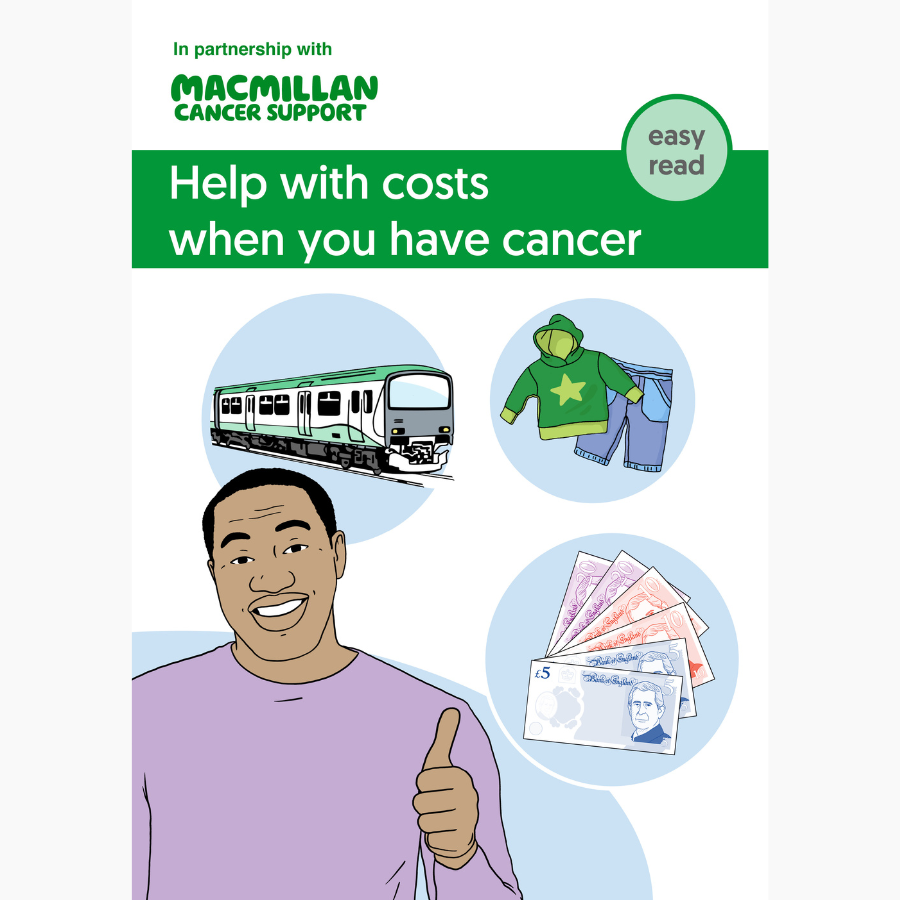
How our money advisers can help you
We know that money is a big and often difficult thing to talk about when you’re living with cancer. You may earn less if you need to stop working or reduce your hours. You may also need to spend more on things like heating or travelling to hospital.
Our specialist money advisers can give you free and confidential advice and help you to find out what benefits and financial support you might be entitled to.
We can help you with:
- a full benefits check to see what you are entitled to apply for
- questions about different benefits such as Universal Credit, Personal Independence Payment (PIP) and Employment and Support Allowance (ESA)
- completing benefit application forms
- challenging decisions on benefit claims.
Support from Macmillan
Macmillan is here to support you. If you would like to talk, you can:
- Call the Macmillan Support Line for free on 0808 808 00 00.
- Chat to our specialists online.
- Visit our Online Community to talk with people who have been affected by cancer, share your experience, and ask your questions.
About our information
This information has been written, revised and edited by Macmillan Cancer Support’s Cancer Information Development team. It has been reviewed by expert medical and health professionals and people living with cancer.


Karin Macdonald
Reviewer
Grants & Welfare Rights Team Leader
Our cancer information meets the PIF TICK quality mark.
This means it is easy to use, up-to-date and based on the latest evidence. Learn more about how we produce our information.
The language we use
We want everyone affected by cancer to feel our information is written for them.
We want our information to be as clear as possible. To do this, we try to:
- use plain English
- explain medical words
- use short sentences
- use illustrations to explain text
- structure the information clearly
- make sure important points are clear.
We use gender-inclusive language and talk to our readers as ‘you’ so that everyone feels included. Where clinically necessary we use the terms ‘men’ and ‘women’ or ‘male’ and ‘female’. For example, we do so when talking about parts of the body or mentioning statistics or research about who is affected.
You can read more about how we produce our information here.