


Shaped by lived experience: Azmina’s journey into personalised cancer care
Azmina is the Lead for Personalised Cancer Care (PCC) at Royal Free London NHS Foundation Trust. We spoke with Azmina to learn more about how her own experiences with a pre-cancerous bowel condition inspired her to change career.
'I always try to remember who this person is outside of their cancer treatment. What matters to them? What are their priorities?'
What does personalised cancer care mean?
Personalised cancer care is defined as, “providing patients with access to care and support that meets their individual needs from the moment they receive their diagnosis so that they can live as full, healthy, and active a life as possible.” (NHS Long Term Plan, 2019)
What does a day in the life of a PCC lead look like?
Every day is different. I’m responsible for several hospital sites and regularly check in with my team of Macmillan professionals, including cancer support workers, information and support specialists, and welfare advisers.
When it comes to organising my day, I always prioritise patients first.
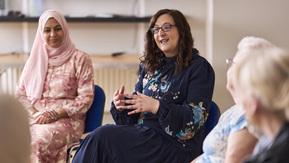
The days I enjoy the most are when I'm leading my pre-treatment group, which is called PREPARE, or facilitating the Macmillan HOPE programme.
What motivated you to become a healthcare professional?
My route to working in cancer care is a slightly unusual one. I didn’t grow up saying, when I'm older I want to be a nurse or doctor.
My first career was in the city. I was working in corporate finance in my early 20s. Then unfortunately, I became ill and ended up in hospital with what was known then as a pre-cancerous bowel condition.
I had been quite poorly. I had lots of stomach problems and couldn't keep any food down. My healthcare team first thought that I was having a flare up of Crohn's disease.
After some tests, they told me they’d found pre‑cancerous cell changes and that I needed surgery, as it was only a matter of when—not if—it became cancer. I had major surgery where a large part of my bowel was removed, and I now have a stoma bag.
I decided I couldn’t return to my job in the city. So, I went back to university and retrained as a healthcare professional.
I was full of gratitude to the NHS for having caught this early and decided to use my own experience to try to help people.
Why culture and representation matter
Becoming a healthcare professional mattered to me for many reasons. During my own operation, I didn’t see my age or my cultural background represented in many of the cancer support materials or the healthcare professionals caring for me.
There were also some cultural issues I dealt with. For example, a nurse told me that I wouldn’t be able to find a husband because of the stoma bag. I think she assumed that just because I come from a Gujarati family, I would have an arranged marriage, which isn’t the case.
It made me very aware that people from minority backgrounds do face some additional complexities.
At the time, there also wasn’t much information available to help a young person understand what life would be like with a stoma. Things like dating and going clubbing. It was mainly aimed at older people back then.
How does your lived experience influence your work?
My lived experience is what helps me bridge the gap between the terminology of oncology and plain English. Having been through something myself, for example, a particular type of imaging scan or a particular medical procedure, helps me to explain it to others in simple and understandable ways.
Even though my own personal experience was a long time ago, I still think of things that I wish I had been told. There are practical details that I still remember, like how long a particular appointment usually takes or how a certain treatment feels.
These small pieces of information can make a big difference by helping people to understand exactly what to expect. Knowing more about what to expect can really help to reduce anxiety and worry.
I’m always mindful that while someone is a patient in the hospital, they still have responsibilities waiting for them at home. As well as being a cancer patient they have many other important roles. When they go home, they’re still a parent, a sibling, a colleague, or part of their community. Those roles are important and they don’t stop.
I always try to remember who this person is outside of their cancer treatment. What matters to them? What are their priorities?
I think about how I can support them to stay true to themselves while they take on this new identity of living with and beyond cancer.
What advice would you give someone preparing for a hospital appointment after being diagnosed with cancer?
People can feel overwhelmed about their appointments, especially in the early days, and they may worry the oncology doctor won’t have the time to answer all their questions and address their concerns.
We hear so much about the pressures that the NHS is facing, and so I can understand why that might be the perception. I often suggest writing questions down in advance or recording a voice note to help remember things. Otherwise, it’s easy to forget to ask the doctor everything.
If someone is particularly worried or anxious, I might also suggest practising beforehand. Talk it through with someone and rehearse what you need to say. By the time you speak to your doctor or nurse, you will be able to communicate more confidently because you’re not thinking about what to say.
I might also recommend role-playing to my patients when they are worried about telling a loved one about their diagnosis. Particularly when it comes to talking to teenagers or children, I say to patients, let's practice now, right here in the hospital, so that when you get home your words will come more easily.
One of the other things that I'm responsible for in my role are the health and wellbeing events. We do things like a pre-treatment information and support session, where we cover questions about diagnosis, emotional reactions to having cancer, side effects of treatment, and healthy lifestyle factors such as eating well and staying active.
I always encourage patients to bring someone with them, so if they feel shy or unsure that other person can speak up for them. Having a companion is also helpful because they can be an extra pair of eyes and ears.
My colleagues and I are here to offer advice, information, and support. We make sure patients feel comfortable talking about anything with us. I always tell them I will have heard it before, so they can ask me anything, literally any question from A to Z.
Hear more from Azmina
Hear Azmina and others talk about their cancer experiences and the support they received:
Get involved with Macmillan
More stories like this
-
Stories 14 Mar 2024Ellie, 22, was diagnosed with Rhabdomyosarcoma (a soft tissue sarcoma) in 2015 when she was just 14 years old. The effect of her cancer treatment has meant that Ellie is unable to have penetrative sex...
-
Stories 05 Aug 2024When you finish cancer treatment you may feel a range of different emotions. On this page storytellers share their experiences of life after cancer treatment.
-
Stories 01 Feb 2023Martha’s story highlights the importance of cervical screening and the emotional impact of a cancer diagnosis.
How we can help