


Claiming bereavement benefits
If your partner has died, you may be able to claim Bereavement Support Payment. You cannot claim this for other family members who have died.
What are bereavement benefits?
If your partner died on or before 5 April 2017, you may already have got or be getting the following benefits:
- Bereavement Payment – a tax-free bereavement payment.
- Bereavement Allowance (was called Widow’s Pension). This is a weekly payment for people who were aged 45 and over, but under the State Pension age, when their partner died.
- Widowed Parent's Allowance – a weekly payment for people who have children or young adults and are receiving Child Benefit.
Bereavement Support Payment has replaced these benefits. If you are making a new claim and your partner died on or after 6 April 2017, apply for Bereavement Support Payment instead.
If you have children
If you are already getting Widowed Parent's Allowance, you will continue to get that benefit in the same way as before. You can find out more about these older benefits at GOV.UK
Related pages
Bereavement Support Payment
If you claim Bereavement Support Payment, it is important to know the following:
- You must apply within 3 months of the death of your partner to get the full amount. You can apply up to 21 months after the death, but your payments will be less.
- You first get a lump sum payment and then up to 18 monthly payments. The lump sum payment is to help pay for extra costs resulting from the death of your partner.
- There are 2 different rates. If you are entitled to Child Benefit, you get the higher rate. Otherwise, you get the lower rate unless you were pregnant when your partner died.
- Bereavement Support Payment is not counted when working out the benefit cap. This is a limit on the total amount of benefit you can get. But getting Bereavement Support Payment does not mean that the benefit cap does not apply to you.
- The lump sum Bereavement Support Payment does not affect your benefits for 1 year after your first payment. After 1 year, any payment you have left over could affect the amount of benefit you get. You must tell your local Jobcentre Plus when you start getting Bereavement Support Payment.
- The 18 monthly payments are not treated as income for means tested benefits. But if you have not spent the money, it may count as savings when you apply for other benefits.
How can I claim?
If you live in England, Scotland or Wales, you can download a Bereavement Support Payment form (BSP1) at GOV.UK. Or you can order the form over the phone from your local Jobcentre Plus.
For more information, call the Bereavement Service helpline on 0800 151 2012 or 0800 731 0453 for Welsh language. Or use textphone 0800 731 0464.
If you live in Northern Ireland, you can apply online or download a claim form at NI Direct. Or call the Bereavement Service on 0800 085 2463 or use textphone 0808 100 2198.
Who can claim?
You can only get Bereavement Support Payment if you were under the State Pension age when your partner died.
You may get it if you were married or in a civil partnership when your partner died.
Or you may get it if you were living together as if married and you were:
- getting Child Benefit
- told by the Child Benefit Office that you were entitled to Child Benefit for a child who lived with you, even if you chose not to get it
- pregnant.
To claim, your partner must either have:
- paid a certain amount of National Insurance contributions
- died because of an accident at work or a disease caused by work
- never been able to work due to a disability.
You cannot claim if you were divorced, or your civil partnership ended before they died.
Other support with bereavement
You may also be able to get help towards funeral costs if you get certain benefits. We have more information about planning a funeral for someone.
For more information, call our money advisers on 0808 808 00 00, Monday to Friday, 8am to 6pm. Visit macmillan.org.uk/inyourarea to find out if you can visit a Macmillan welfare rights adviser in person.
We have more information about coping with loss and bereavement.
You may also find it helpful to connect with people who have been through a similar experience. We have different forums on our Online Community:
Booklets and resources
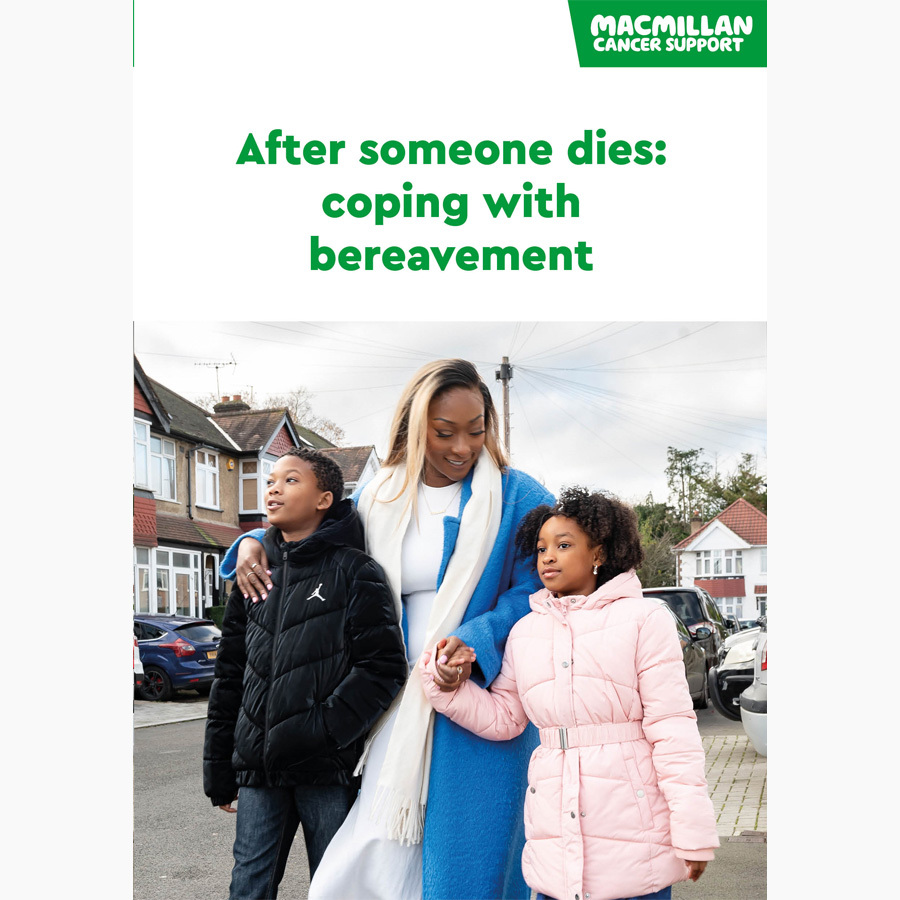
About our information
This information has been written, revised and edited by Macmillan Cancer Support’s Cancer Information Development team. It has been reviewed by expert medical and health professionals and people living with cancer.
-
References
Below is a sample of the sources used in our benefits information. If you would like more information about the sources we use, please contact us at informationproductionteam@macmillan.org.uk
GOV.UK www.gov.uk [accessed May 2025].
NI Direct www.nidirect.gov.uk [accessed May 2025].
Social Security Scotland www.socialsecurity.gov.scot [accessed May 2025].


Macmillan Welfare Rights Team
Reviewer
Date reviewed


Our cancer information meets the PIF TICK quality mark.
This means it is easy to use, up-to-date and based on the latest evidence. Learn more about how we produce our information.
The language we use
We want everyone affected by cancer to feel our information is written for them.
We want our information to be as clear as possible. To do this, we try to:
- use plain English
- explain medical words
- use short sentences
- use illustrations to explain text
- structure the information clearly
- make sure important points are clear.
We use gender-inclusive language and talk to our readers as ‘you’ so that everyone feels included. Where clinically necessary we use the terms ‘men’ and ‘women’ or ‘male’ and ‘female’. For example, we do so when talking about parts of the body or mentioning statistics or research about who is affected.
You can read more about how we produce our information here.