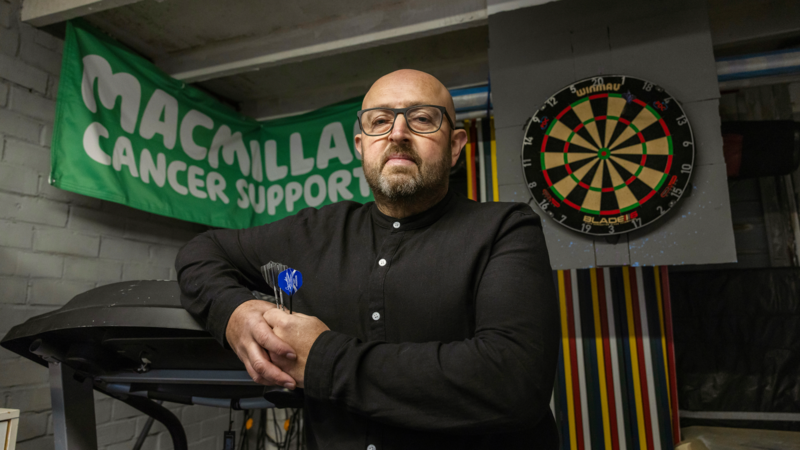
Denzil's diagnosis
After surviving Covid-19 pneumonia so severe that it necessitated a hospital stay in October 2021, Denzil thought the worst was behind him. Discharged and recovering at home, he assumed life would slowly return to normal. But 4 weeks later, everything changed.
A sudden, excruciating pain tore through his abdomen “like a hot knife deep inside me.” It kept him awake all night. Over the next few months, Denzil made multiple visits to his GP surgery and walk-in centres, having blood tests that revealed only a low platelet count, which he was told at one point was possibly due to his ethnicity.
Meanwhile, the pain came and went at random. “It ranged from seconds, to minutes and hours… There was no rhyme, reason or pattern to it.” Denzil continued to press for answers. His persistence finally paid off and he was sent for scans.
The results were not good – it was colon cancer – but when Denzil eventually sat down for his face‑to‑face results appointment, he went alone. “I never thought cancer was even a possibility.”
The next 24 hours were a complete blur, an “out-of-body” experience. With the care and support of his family and friends, Denzil slowly began to come to terms with the news. A week-long family break in Wales provided a much-needed change of scenery. “It was a productive week and it allowed us to bond. It allowed us to reset and have hope. Hope is such a big word."
“Cancer has changed my whole life… but my attitude has always been, I’m not in here with you. You’re in here with me.”
Denzil's support network helped him during his treatment
Denzil’s chemotherapy treatment took place over several months. It was a constant round of treatment cycles, side effects, and delays. “My mind and body were all over the place… It was a mixture of frustration, fear and hope. And I am still suffering from heavy fatigue to date, and my sleep patterns remain sporadic.”
For a long while, treatment became his life. “One day drifted into another. Tablets in the morning and tablets in the evening. The hot water bottle was my friend. I was so cold.” One of Denzil’s lowest points was when he started peeing blood. “I called the emergency hotline number that had been given to me… and was instructed to go to A&E immediately. The doctor was so calm as I was having a meltdown on the phone. I was completely traumatised and scared. I actually thought that I was going to die!”
A blood test and other investigations revealed that Denzil was suffering from neutropenic sepsis, a common and potentially life-threatening infection that can be a complication of chemotherapy treatment. Quick action is vital, and Denzil’s swift response to his symptoms meant he was able to receive the medication needed to treat the condition.
Despite these many challenges, Denzil recalls the compassion of NHS staff in the Snowdrop ward, with deep gratitude. Having a strong support network at home and during treatment helped Denzil throughout his cancer experience.
Sadly, this was something his elder brother, Carlton, was unable benefit from. "My brother, Carlton, passed away from cancer in late March 2022, from cancer of the oesophagus. He kept the diagnosis to himself and nobody, not even his mum, knew about the diagnosis.”
“Men do not talk in these moments of doubt and uncertainty, and this is particularly the case with men of colour.”
Creating the space for others
After his own treatment, Denzil transformed his lifestyle, prioritising positivity, health, and faith. He created a men’s walking group to give others the space he once needed. “A safe space for us to discuss anything and everything free from judgement… It’s not a sign of weakness to ask for help or to share their feelings. For me, it is a sign of strength.
“The walk and talks have been going for three years now and have been so beneficial to us all. One of the guys told me recently that the Saturday meet ups are ‘oxygen’ to him. Saturdays are now integral to our wellbeing.”
His brother’s death from cancer deepened Denzil’s mission. Supported by Macmillan, he has become a cancer champion, raising awareness of cancer among other community members. “Men do not talk in these moments of doubt and uncertainty, and this is particularly the case with men of colour.”
Denzil shares his story to encourage annual health checks and earlier conversations. “I’m so grateful to be here. If I can save just one life by sharing my experience, it will be worth it. I’m here for a reason. I’m just here to make a difference.”