


Support for LGBTQIA+ people affected by cancer
If you are LGBTQIA+ and living with cancer, get information and support that feels right for you.
Get the information you need about cancer
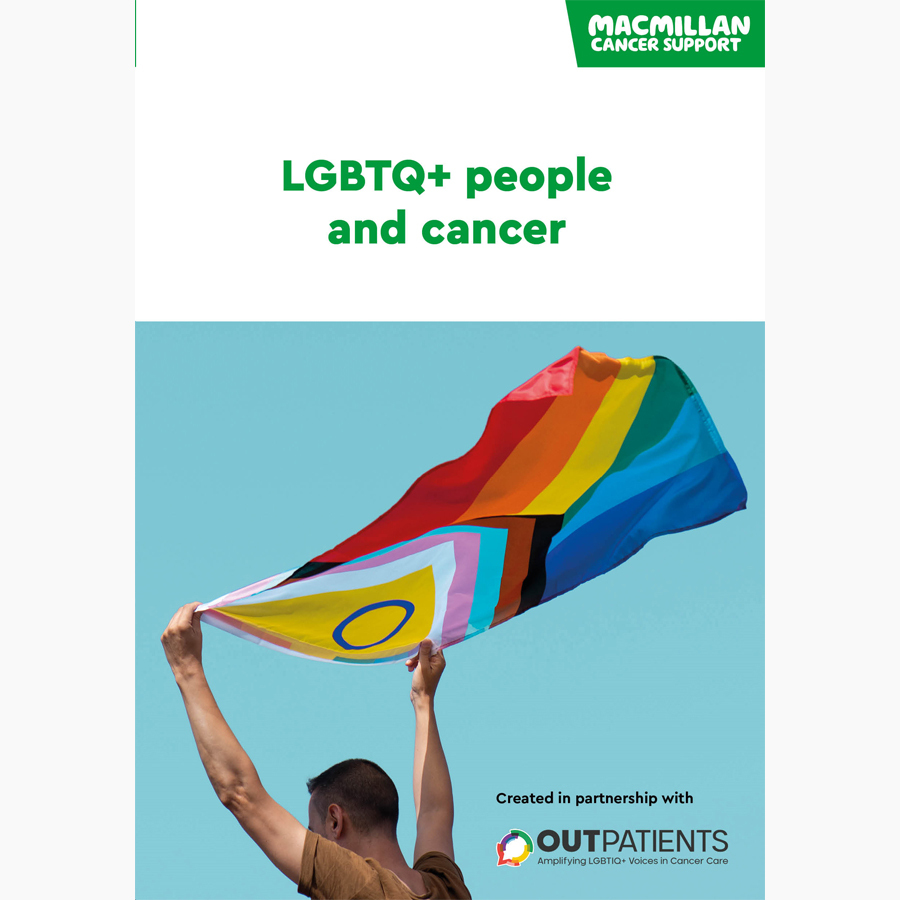
Our cancer and LGBTQIA+ information was developed in partnership with OUTpatients – a cancer support and advocacy charity for the LGBTQIA+ community.



Cancer screening information
Cancer screening helps by finding and diagnosing cancers at an early stage, or even preventing them.
The NHS offers routine screening for breast, cervical and bowel cancer. In some areas, there is also screening for lung cancer. Invitations are usually based on your age and the gender that is registered with your GP.
There can be additional barriers for LGBTQIA+ people that make cancer screening more complicated. These include lack of information about who can have screening, not being invited, and gender dysphoria.
Whether or not you have screening is your choice. It is important to understand what’s involved so that you can make an informed decision.
Breast screening
Breast screening is offered to anyone who is registered as female with their GP, and aged between 50 and 70. If you have a strong family history of breast cancer, you may be offered regular breast screening before the age of 50. If you are over 70, you can self-refer through your GP.
If you are transgender (trans) or non-binary, talk to your GP or practice nurse about breast screening.
- You should consider going for breast screening if you have developed breasts through feminising hormone therapy. But you may not be invited automatically if you are registered as male with your GP.
- You will not be able to have breast screening tests if you have had top surgery. But you may still receive screening invitations if you are registered female with your GP.
We have more information for trans and non-binary people. It includes information about having tests and treatment, and getting support.
Learn more about breast screening from other organisations:
Cervical screening
A walk-through of cervical screening
Watch the video below from My Cervix My Service from CliniQ for an explanation on what happens during a cervical screening at this trans specific clinic. This can help you prepare for your appointment and answer practical questions you might have about screening as experiences will vary in standard NHS clinics.
You can watch the video with subtitles by clicking on the settings cog on the right hand side of the screen and selecting 'subtitles / CC'.
You should consider cervical screening if you were born with a cervix and still have it. The cervix is the lower part of the womb (uterus) that joins to the top of the vagina.
Cervical screening is important for anyone with a cervix who has ever:
- been sexually active, whatever their sexual orientation
- put anything inside their vagina, including fingers and tampons.
Cervical screening is automatically offered to anyone who is registered as female with their GP and aged between 25 and 64. If you are registered as male with your GP and have a cervix, you can arrange cervical screening in the following ways:
- In England and Wales, talk to your GP. If you want ongoing screening appointments and reminders, ask them about opting-in for this. If you have arranged a screening appointment, you can also ask about opting-in at your appointment.
- In Scotland, you will be invited if you have not changed your CHI number, or if you changed it after 14th June 2015. Talk to your GP if you changed your CHI number before this.
- In Northern Ireland, talk to your GP for more information about arranging the screening you need.
Our cervical screening information provides more details about screening and why it is recommended.
We have more information for trans and non-binary people. It includes content about having tests and treatment and getting support.
If you have any questions about your cervical screening invites, you could also talk to your GP, practice nurse or local sexual health service.
Learn more about cervical screening from these organisations:

Talking to your healthcare team
You do not have to tell your healthcare team you are LGBTQIA. But it may help them give you the right care and support.
For example, it can help your team:
- understand which screening you may need
- answer questions about your body, treatment or sexual wellbeing
- make sure tests and scans are safe for you
All healthcare professionals should treat your information confidentially and with respect. It is against the law to discriminate based on sexual orientation, sex, transgender identity or history.
We also know that healthcare does not always work as it should. Some LGBTQIA+ people experience assumptions, incorrect pronouns or unfair treatment. This can make screening feel more difficult.
Information to help you whatever you're going through
LGBTQIA+ resources for healthcare professionals
Education can help bridge the gap for healthcare professionals to understand the unique needs of LGBTQIA+ patients and encourage inclusion.


Improving cancer care for the LGBTQIA+ community
Everyone should get the best cancer care, no matter what
Everyone should get the healthcare they need. Being LGBTQIA+ does not change this. But we know that sometimes LGBTQIA+ people face extra challenges in getting the right help.
If feel you or someone you know is being treated unfairly or being discriminated against, read our information about being LGBTQIA+ and getting the right support.
Other organisations that can help

Mind has information about mental health support for LQBTQ+ people.
LGBT Foundation provide a wide range of services to support lesbian, gay, bisexual and trans people.
Switchboard LGBT+ helpline offer a safe space for people to ask questions about any topics relating to sexuality.

The Teenage Cancer Trust have support for young LGBTQ+ people with cancer and their families.
Get information you can trust
Working in collaboration
All our cancer information is written and reviewed by our team of cancer experts. Our medical information has the PIF tick, meaning it meets the criteria for high standard medical information. Find out more about how we produce our information and our expert team.
This webpage was produced in consultation with Macmillan’s LGBTQIA+ staff network. Learn more about how Macmillan are working on building an inclusive organisation.
Date reviewed
Reviewed: 06 July 2026 | Next review: 06 July 2029The language we use
We want everyone affected by cancer to feel our information is written for them.
We want our information to be as clear as possible. To do this, we try to:
- use plain English
- explain medical words
- use short sentences
- use illustrations to explain text
- structure the information clearly
- make sure important points are clear.
We use gender-inclusive language and talk to our readers as ‘you’ so that everyone feels included. Where clinically necessary we use the terms ‘men’ and ‘women’ or ‘male’ and ‘female’. For example, we do so when talking about parts of the body or mentioning statistics or research about who is affected.
You can read more about how we produce our information here.
What does LGBTQIA+ stand for?
LGBTQIA+ stands for Lesbian, Gay, Bisexual, Transgender, Queer/Questioning, Intersex, Agender/Aromantic/Asexual.
The plus (+) includes any romantic or physical attraction other than heterosexual, and any gender identity other than cisgender.
Cisgender is a term for someone who identifies as the same gender they were assigned at birth. For example, someone who was assigned male at birth and identifies as male, is a cisgender man.
You can find more information and definitions on the Stonewall website.
In our information, we link out to external resources that use more binary language. We include it as the information may still be relevant and helpful for LGBTQIA+ people.