


Cancer and employment rights
Is cancer a disability?
If you have cancer, the law considers this a disability. This means you cannot be treated less favourably than people who do not have cancer because you have cancer.
You also cannot be treated less favourably for reasons connected to the cancer. That would be discrimination.
There are laws that protect you from being discriminated against at work because of cancer. If you live in:
- England, Scotland or Wales, the Equality Act 2010 protects you
- Northern Ireland, the Disability Discrimination Act 1995 protects you.
These laws do not just protect employees. They also protect people who are:
- classified as workers – for example, people who work for an agency
- applying for jobs
- self-employed – this is on a case-by-case basis.
We have information about these different types of discrimination and examples of discrimination in the workplace.
Carers are also protected from some types of discrimination. We have more information about cancer and employment rights as a carer.
Related pages
Is cancer in remission considered a disability?
The legal protection against discrimination does not end when your cancer treatment finishes.
If you have been diagnosed with cancer in the past, you will continue to have legal protection against discrimination even if you no longer have cancer. You will also have protection if you move to another employer.
Which areas of employment are covered?
The Equality Act and the Disability Discrimination Act cover all areas of employment. This includes:
- recruitment
- terms and conditions of employment, and any benefits
- opportunities for promotion and training
- ending your employment.
We have more information about the types of discrimination that you are protected against.
How to check your employment rights
There are many ways to check your employment rights for free. You can:
- check your employer’s policies if your company has them
- talk to a human resources (HR) manager if your company has one
- contact your trade union if you are a member
- find out more about getting help with money and work
- contact Citizens Advice if you live in England, Scotland or Wales, and Advice NI in Northern Ireland
- visit gov.uk if you live in England, Scotland and Wales or nidirect.gov.uk if you live in Northern Ireland
- contact the Equality Advisory Support Service if you live in England, Scotland or Wales, or the Equality Commission for Northern Ireland for free, confidential advice
- contact the Advisory, Conciliation and Arbitration Service (Acas) if you live in England, Scotland or Wales, or the Labour Relations Agency if you live in Northern Ireland.
If you think your employer is not respecting your rights, it is a good idea to talk to an employment lawyer or an employment organisation.
There may be professional groups in your area that can give you advice about employment issues. You can ask your specialist nurse if there are any groups near you.
Related pages
Booklets and resources
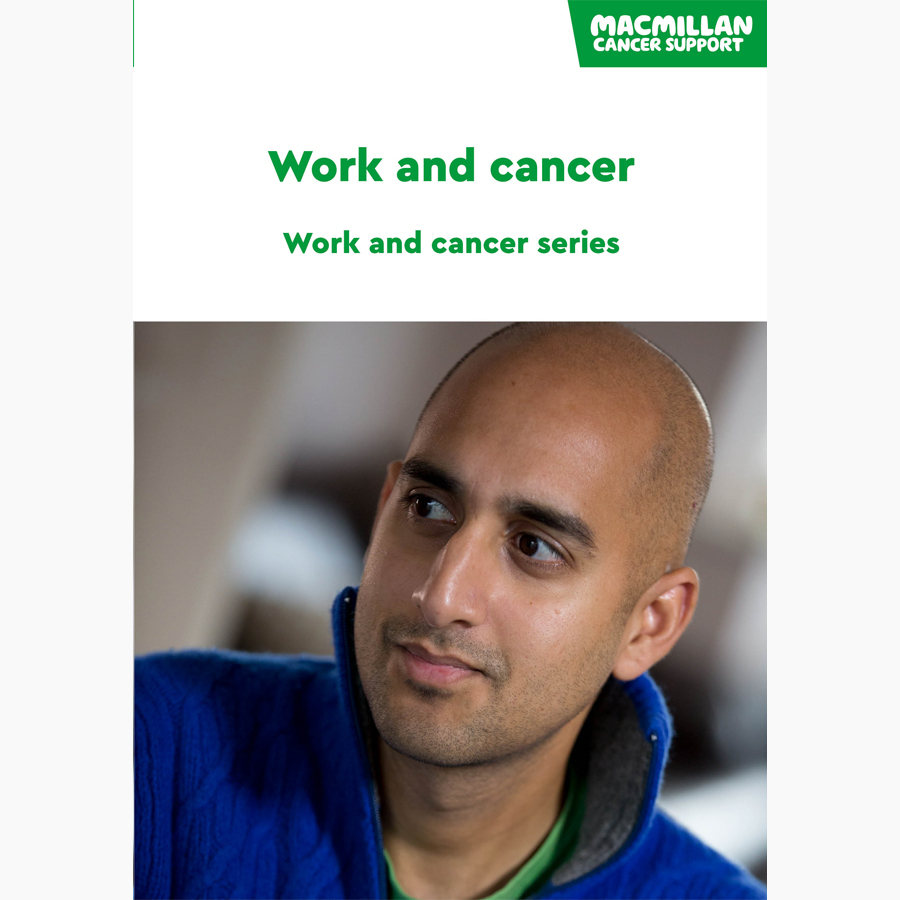
Reasonable adjustments
Both the Equality Act and the Disability Discrimination Act say that if your employer is aware of your disability, they must try to make reasonable adjustments.
These are changes to the workplace or your job that allow you to keep working or return to work. Examples of reasonable adjustments could include:
- different working hours
- time off to go to medical appointments
- extra breaks.
We have more information about reasonable adjustments and returning to work.
Confidentiality
Everyone who lives in the UK has the right to have their personal information kept private. This includes medical information. This right is protected under the Human Rights Act 1998, the Data Protection Act 2018 and the General Data Protection Regulation (EU) 2016.
The Access to Medical Reports Act 1988 also says that your employer must ask you for your permission to get a medical report on your health from your doctor or other health professional. You have the right to:
- ask for and see the report before it is given to your employer
- refuse permission for them to get the report.
You may want to talk to your employer about whether you want colleagues and clients to be told about your condition. Your employer should not give out this information without your permission (consent).
Your employer should take care to protect your personal records, including emails and any meeting notes containing details about your condition. This type of personal data should only be used with your permission.
Flexible working
If you are a carer, flexible working could make it easier for you to keep working while caring for someone. Carers have a legal right to request flexible working. At the moment, this right only applies if you:
- are an employee
- have worked for your employer for at least 26 continuous weeks before your request.
This law is currently in the process of being changed.
About our information
-
References
Below is a sample of the sources used in our work and cancer information. If you would like more information about the sources we use, please contact us at cancerinformationteam@macmillan.org.uk
Citizens Advice www.citizensadvice.org.uk (accessed May 2022).
GOV.UK www.gov.uk (accessed May 2022).
NI Direct www.nidirect.gov.uk (accessed May 2022).
-
Reviewers
This information has been written, revised and edited by Macmillan Cancer Support’s Cancer Information Development team. It has been approved by Michelle Rouse Griffiths, Professional Development and Knowledge Lead, Macmillan Cancer Support.
Our cancer information has been awarded the PIF TICK. Created by the Patient Information Forum, this quality mark shows we meet PIF’s 10 criteria for trustworthy health information.
The language we use
We want everyone affected by cancer to feel our information is written for them.
We want our information to be as clear as possible. To do this, we try to:
- use plain English
- explain medical words
- use short sentences
- use illustrations to explain text
- structure the information clearly
- make sure important points are clear.
We use gender-inclusive language and talk to our readers as ‘you’ so that everyone feels included. Where clinically necessary we use the terms ‘men’ and ‘women’ or ‘male’ and ‘female’. For example, we do so when talking about parts of the body or mentioning statistics or research about who is affected.
You can read more about how we produce our information here.
Date reviewed


Our cancer information meets the PIF TICK quality mark.
This means it is easy to use, up-to-date and based on the latest evidence. Learn more about how we produce our information.