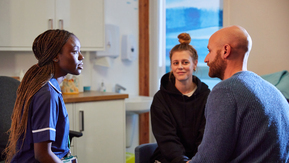
Your care will be organised by a team of specialists with experience in managing endocrine tumours. This multidisciplinary team (MDT) will often include:
- an endocrinologist doctor who specialises in disorders of the endocrine system
- a surgeon who specialises in endocrine glands
- a cancer doctor (oncologist) who specialises in treating endocrine cancers
- a radiologist – a specialist in x-rays and scans
- a pathologist – a specialist in examining tissues and cells samples to diagnose tumours
- a specialist endocrine nurse who can give you support and information.
The main treatment for parathyroid cancer is surgery. It is often the only treatment needed. Surgery can also be used to treat cancer that comes back again or if the cancer spreads to other areas of the body.
Rarely, radiotherapy is used to reduce the risk of cancer coming back after surgery. Chemotherapy may be given if you can’t have surgery. You may also have other treatments to control the level of calcium in your blood.
Surgery
The surgeon removes the cancer and any nearby affected areas. They will remove one or more of the parathyroid glands and part or all of the thyroid gland. They may also remove nearby lymph nodes. Usually, you have a general anaesthetic for surgery. You will need to stay in hospital for a few days.
Surgery may also be used to remove cancer that has come back in the neck area or cancer that has spread, for example to the brain or lungs. Your specialist can give you more information about these types of operation.
After parathyroid gland surgery
The calcium levels in your blood may take two or three days to go back to normal after surgery. You will have regular blood tests to check the calcium levels. If the level is too low, your doctor will prescribe extra calcium as an injection into a vein (intravenously) or as tablets. You may also be prescribed Vitamin D supplements to help your body absorb calcium.
You are likely to have some small scars on your neck after the operation. These usually fade as they heal. Rarely, surgery can damage a nerve in the neck. This can cause hoarseness or problems with how you swallow. You may need further treatment for this.
Radiotherapy
Radiotherapy is not often given for parathyroid cancer. But you may have it after surgery to reduce the risk of the cancer coming back.
This treatment uses high-energy rays to destroy cancer cells. You have treatment in small doses (called fractions) over a few weeks from a radiotherapy machine similar to an x-ray machine. It does not make you radioactive.
Side effects of radiotherapy
You may develop side effects during radiotherapy. These usually disappear gradually over a few weeks or months after treatment finishes. Your radiotherapy team will let you know what to expect. Tell them about any side effects you have. There are often things that can be done to help.
Your skin may become sore, dry and red (or darker if you have dark skin) in the area being treated. Your radiotherapy team will give you advice about skin care during treatment.
Your throat may become sore after a couple of weeks of treatment. This can affect eating and your voice may also become hoarse. You will be given help and support to cope with this.
We can have more information about radiotherapy and coping with side effects.
Chemotherapy
This treatment uses anti-cancer (cytotoxic) drugs to destroy cancer cells. You may have chemotherapy if surgery isn’t possible. Chemotherapy is carried around the body in the bloodstream, so it can treat cancer wherever it is.
Side effects of chemotherapy
The side effects depend on the drug or combination of drugs you are given. Your doctor or nurse will explain any treatment you are offered and what to expect. Let them know about any side effects during treatment. They can often give you advice or prescribe drugs to reduce these.
Most chemotherapy drugs can reduce the number of white cells in your blood during treatment. This will make you more likely to get an infection. Your doctor or nurse will give you advice about what to do if this happens.
Chemotherapy can also cause other side effects such as feeling tired, a sore mouth, feeling sick (nausea) or being sick (vomiting), diarrhoea and hair loss.
We can send you more information about coping with the side effects of chemotherapy and about different chemotherapy drugs.
Radiofrequency ablation
This treatment is sometimes used to treat parathyroid cancer that has spread to another part of the body (secondary cancer). It uses heat to destroy cancer cells, and helps to reduce the level of parathyroid hormone being made in the body.
Your doctor will give you a local anaesthetic and sedation before the treatment begins. In some cases, general anaesthetic is used instead. Your doctor will place a needle into the tumour. This is usually done using a CT scanner to make sure the needle is in the right place. The doctor then passes radiowaves down the needle into the tumour to heat and destroy the cancer cells.
There are few side effects with this treatment, although you may have some discomfort or tiredness afterwards. You’ll usually need to stay in hospital overnight.
Clinical trials
Cancer research trials are carried out to try to find new and better treatments for cancer. Trials that are carried out on patients are known as clinical trials.
Research into treatments for parathyroid cancer is ongoing and advances are being made. But because it’s a rare type of cancer, there may not always be a trial in progress. If there is you may be asked to take part. Your doctor must discuss the treatment with you so that you have a full understanding of the trial and what it means to take part. You may decide not to take part or to withdraw from a trial at any stage. You will still receive the best standard treatment available.