


Colonoscopy
What is a colonoscopy?
A colonoscopy is a way of examining the lining of the bowel from the inside. A doctor or nurse passes a thin flexible tube (colonoscope) into your back passage. The tube has a tiny light and camera on the end to show any abnormal areas.
A colonoscopy can also see whether there are any small growths (polyps) in the lining of the bowel. It is one of the main tests used to diagnose bowel cancer. The procedure is usually done in the hospital outpatient department and takes about 30 minutes.
View the video without BSL interpreter on our YouTube Channel.
Booklets and resources
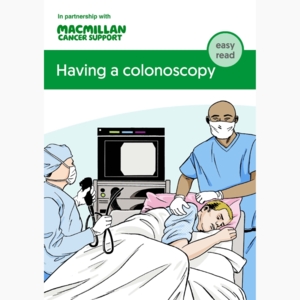
What happens during a colonoscopy?
During the colonoscopy, photographs and samples (biopsies) of the cells on the inside of the large bowel can be taken. Most polyps can be painlessly removed using a wire loop that is passed down the colonoscope.
Preparing for a colonoscopy
The bowel has to be completely empty for a colonoscopy. This means following a careful diet for a few days before your test.
You will also need to take laxatives, which the screening centre or hospital pharmacy will provide. The department carrying out your colonoscopy will give you instructions about your diet, and about exactly when to take your laxatives.
Having the test
Shortly before the colonoscopy, you may be given a sedative to help you feel relaxed. Once you are lying comfortably on your side, the nurse or doctor will gently pass the colonoscope into your back passage. The tube is made up of flexible fibres so it can easily pass around the curves of the bowel.
Having a colonoscopy can be uncomfortable. If you do have pain, it is usually mild. If you find it very painful, tell the doctor or nurse straight away. They may give you Entonox®, which is a gas that can relieve pain. It is sometimes called gas and air. You breathe it in through a mouthpiece.
Sometimes it is not possible to see the whole bowel during a colonoscopy. This can happen if the bowel is not completely empty or if the colonoscope can't pass around a bend in the bowel to reach the end.
If this happens, you may be asked to have another colonoscopy or a virtual colonoscopy.
After a colonoscopy
Most people are ready to go home a couple of hours after their test. If you have a sedative, you will need someone to collect you from the hospital. After having a sedative you should have someone with you for 12 hours. You should not drive for 24 hours afterwards.
If you only had Entonox® (gas and air), you should be able to drive home when the nurses say you have recovered. You will not need someone to stay with you overnight.
It is rare to have any serious problems after the test. Contact your GP or go to your nearest emergency department (A&E) straight away if you:
- have severe tummy pain
- have a high temperature
- are being sick
- are bleeding from the back passage.
Risks of a colonoscopy
Most people who have a colonoscopy have no problems. But rarely, there can be problems.
A small number of people have heavy bleeding after having a polyp removed or a biopsy. This can usually be treated quickly during the test. But some people may need to be admitted to hospital to have this treated.
Rarely, the bowel can be torn or damaged. If this happens, you will usually need an operation to repair the tear.
Very rarely, a person may die as a result of having a colonoscopy. This happens in about 1 in every 10,000 colonoscopies. You will be assessed before you have a colonoscopy to check it is suitable for you. If the assessment shows you may be at a higher risk of problems, you will be offered a different test.


Our cancer information meets the PIF TICK quality mark.
This means it is easy to use, up-to-date and based on the latest evidence. Learn more about how we produce our information.