


Benefits and financial support
If you are affected by cancer, you may be able to get benefits to help with extra costs, or to support you if you need to stop working.
On this page
-
What benefits can I claim if I have cancer?
-
Benefits if you cannot work or have a low income
-
Benefits for people of pension age
-
Disability benefits
-
Help with children’s costs
-
Help with bills and housing costs
-
Help with health costs
-
Help with transport and parking
-
Benefits at end of life (special rules)
-
Carer’s benefits
-
Bereavement benefits
-
Benefits glossary
-
Get information about benefits in another language
-
How we can help
What benefits can I claim if I have cancer?
Benefits are payments from the government to people who need financial help. You can find out more on this page about the benefits you might be able to claim if you have cancer.
Each benefit has rules about who can claim. Sometimes the rules are complicated, and some benefits overlap in ways that affect what you get. We have information to help you get the support you need:
- Call us free on 0808 808 00 00 to talk to a Macmillan money adviser, Monday to Friday, 8am to 6pm.
- Use our online Benefits Calculator to get estimates of which benefits you may be entitled to.
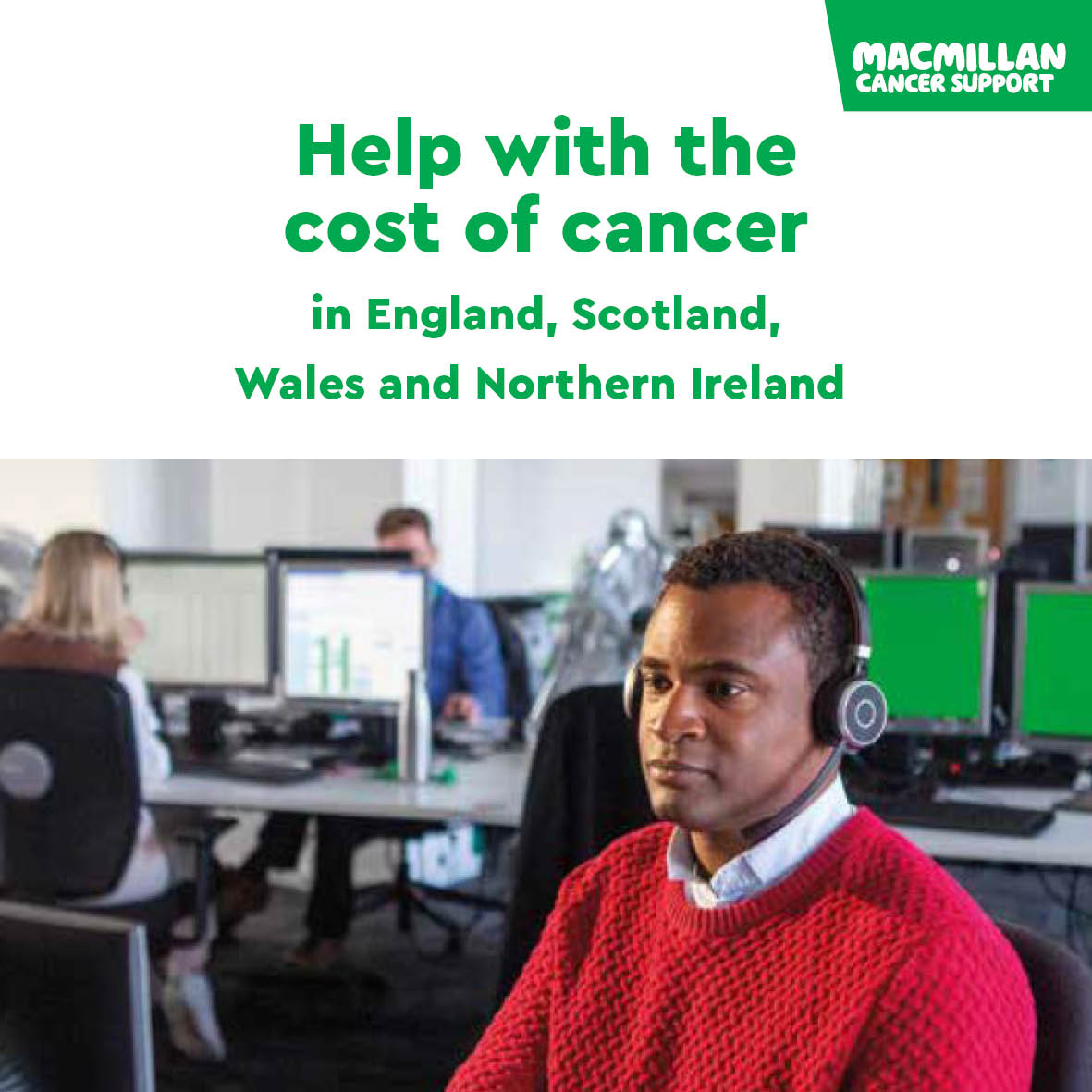
If you prefer a booklet, get a copy of Help with the cost of cancer. You can use our Finding the right benefits and help leaflet to quickly find the sections that might be right for you.
Booklets and resources
Benefits if you cannot work or have a low income
If cancer, or another factor, affects how much you work or are earning, the following benefits might help:
- Employment and Support Allowance - for people under State Pension age who have an illness or disability that affects how much they can work.
- Universal Credit - for people under State Pension age who are either out of work, or on a low income.
- Jobseeker’s Allowance – for people who are unemployed, able to work and seeking work.
Sick pay and work support
If you work for an employer and take time off sick, you may be able to get sick pay. If you do not get sick pay or your payments are going to end soon, your employer should give you a form called SSP1. The form can help you apply for other benefits.
Your employer can also support you in other ways during a cancer diagnosis and treatment. There are laws in place to stop discrimination and schemes to help both you and your employer during this time. Find out more in our information about work and cancer.
If you are self-employed
If you are self-employed, you will not get sick pay. But you can still apply for other benefits if you cannot work or your income decreases.
If you already get other benefits, such as Housing Benefit, get advice before applying for Universal Credit. These benefits will stop, and you may get less money if you apply. You can speak to our money advisers on 0808 808 00 00, Monday to Friday, 8am to 6pm.
Related pages
Income tax
You may be able to get a tax refund if you stop work or your income decreases. You should also check you are paying the correct amount of tax if your situation changes. Your employer may be able to organise this.
You can apply for a tax refund online at GOV.UK or contact HM Revenue and Customs (HMRC) on 0300 200 3300.
Benefits for people of pension age
State Pension is a regular payment you can get from the government when you reach a certain age. The age you get State Pension depends on when you were born.
The State Pension age is increasing in stages. As of October 2020, the State Pension age is 66. It is expected to rise to 67 between 2026 and 2028.
You can check when you will reach State Pension age at GOV.UK or by calling the Future Pension Centre. Call 0800 731 0175 or use textphone 0800 731 0176. Or call 0800 731 0175 for Welsh language.
If you are State Pension age or over and have a low income, you may be able to claim a benefit called Pension Credit.
Related pages
Disability benefits
If cancer, or another long-term health condition or disability, affects your mobility or personal care needs, the following benefits might help.
If you are under State Pension age:
- Personal Independence Payment – for people living in England, Wales or Northern Ireland who have problems with everyday tasks, getting around or both due to long-term health conditions or disability.
- Adult Disability Payment – for people living in Scotland who have problems with everyday tasks, getting around or both due to long-term health conditions or disability.
If you are State Pension age or over:
- Attendance Allowance – for people living in England, Wales or Northern Ireland who have personal care needs because of an illness or disability.
- Pension Age Disability Payment – for people living in Scotland who have personal care needs because of an illness or disability.
If you have a disease or injury caused by a job, training scheme or training course:
Keeping a diary
For some of these benefits, you need to show:
- how your condition affects you
- how often you are affected
- that you have problems looking after yourself.
You can use a diary to record how your condition affects you day to day. You can send your diary as supporting evidence along with your claim form. Other evidence could include reports or care plans from your GP, doctor, nurse or other healthcare professionals.
Help with children’s costs
Child Benefit is the main benefit if you are responsible for a child. If you do not already get this, you can:
- find out more at GOV.UK
- talk to our money advisers on 0808 808 00 00, Monday to Friday, 8am to 6pm.
The following benefits may also help:
- Child Disability Payment - for people in Scotland who have a child with a disability.
- Disability Living Allowance: Children - for people in England, Wales or Northern Ireland who have a child with a disability.
- Scottish Child Payment - for people in Scotland who look after a child.
- Universal Credit: Child or Childcare - extra payments for people that have children and get Universal Credit.
You may also be able to get help with costs for school meals, clothing and travel.
Related pages
Help with bills and housing costs
You may be able to get help to pay the following housing costs:
- Rent - if you get Universal Credit, you may be able to get an extra amount of money called a housing element or payment as part of your Universal Credit. Or you can claim Housing Benefit if you are State Pension age or you live in supported, sheltered or temporary housing.
- Housing costs such as mortgage interest payments, energy bills, council tax or rates.
Help with health costs
You may be able to get financial help with health costs when you have cancer. This can include help to pay for:
- prescriptions
- wigs and fabric supports
- dental treatment
- eye treatment
- special equipment or aids to help you live at home
- care home or care at home charges.
Related pages
Help with transport and parking
Travelling for medical appointments can be expensive if you are having regular treatment and tests. Find out more about help with transport and parking costs. This includes information about the following:
- Blue Badge Scheme – access to closer parking and some free parking for people with certain medical conditions, or who get certain benefits.
- Healthcare Travel Costs Scheme – travel costs refunds for people who have to go to hospital for planned tests or treatments, if you are on a low income, or if you or your partner gets certain benefits.
- Hospital parking.
- Patient Transport Services – help to get to and from hospital.
- General travel schemes and services.
- Road (vehicle) tax exemption.
Related pages
Benefits at end of life (special rules)
If you have found out that your cancer cannot be cured or you are looking after someone with advanced cancer, you may be entitled to benefits or other financial support.
Most people who need care towards the end of their lives qualify for disability benefits.
If you are under State Pension age:
- Personal Independence Payment – for people living in England, Wales or Northern Ireland who have problems with everyday tasks, getting around or both due to long-term health conditions or disability.
- Adult Disability Payment – for people living in Scotland who have problems with everyday tasks, getting around or both due to long-term health conditions or disability.
If you are State Pension age or over:
- Attendance Allowance – for people living in England, Wales or Northern Ireland who have personal care needs because of an illness or disability.
- Pension Age Disability Payment – for people living in Scotland who have personal care needs because of an illness or disability.
Special rules
If you are terminally ill, you can apply for some benefits using a process called special rules. The process can help people nearing the end of life get easier access to some benefits.
A person is terminally ill if their illness is likely to end their life. In England, Wales and Northern Ireland the special rules apply to people who are likely to have less than 12 months to live. The rules in Scotland do not use this timeframe.
Related pages
Carer’s benefits
Carer’s Allowance and Carer Support Payment are the main benefits for carers. But being a carer may also mean you can get other help or payments as part of another type of benefit. If you are getting Universal Credit, you might be able to get the carer element, even if you do not qualify for Carer’s Allowance or Carer Support Payment. And you may be able to apply for Carer’s Credit.
Related pages
Bereavement benefits
Bereavement Support Payment is a benefit for people whose partner has died. You cannot claim this for other family members who have died. But you may be able to get help towards funeral costs if you get certain benefits. We have more in our information about planning a funeral for someone.
Related pages
Benefits glossary
When you are dealing with benefits, you may come across lots of new words and not know what they mean. Some of these words are explained here.
If you need more information or support, you can call the Macmillan Support Line free on 0808 808 00 00.
-
Benefits
Payments from the government to people who need financial help.
-
Benefit cap
A limit on the total amount of money you can get from a benefit.
-
Blue Badge
A badge that allows people with mobility problems to park nearer to where they need to go.
-
Grant
A payment from the government or a charity to help with extra costs such as clothing or heating bills.
-
Income
All the money you have coming in, for example your wages, benefits or a grant.
-
Ill-health early retirement
This is where you are allowed to retire and claim your pension early because of your health. If you have, or have had, cancer this may apply to you.
-
Lump sum
A single, one-off payment, for example from your pension or an insurance scheme.
-
Mandatory reconsideration
A way to challenge a benefits decision if you disagree with the outcome. This is usually a first step before you can appeal a benefits decision.
-
Means-tested benefit
A benefit where the amount of money you get depends on your income or savings..
-
National Insurance
A payment you have to make while working. If you cannot work, you may be able to get National Insurance credits.
-
Reasonable adjustments
If you are ill, these are changes to your job or workplace that allow you to continue working or return to work.
-
Special rules
Rules that allow people to get certain benefits more quickly if they are terminally ill.
-
State Pension
A regular payment you get from the government when you reach a certain age.
-
Tribunal
A place where benefits appeals are heard and decided.
-
Workplace pension
A pension arranged through your employer.
Get information about benefits in another language
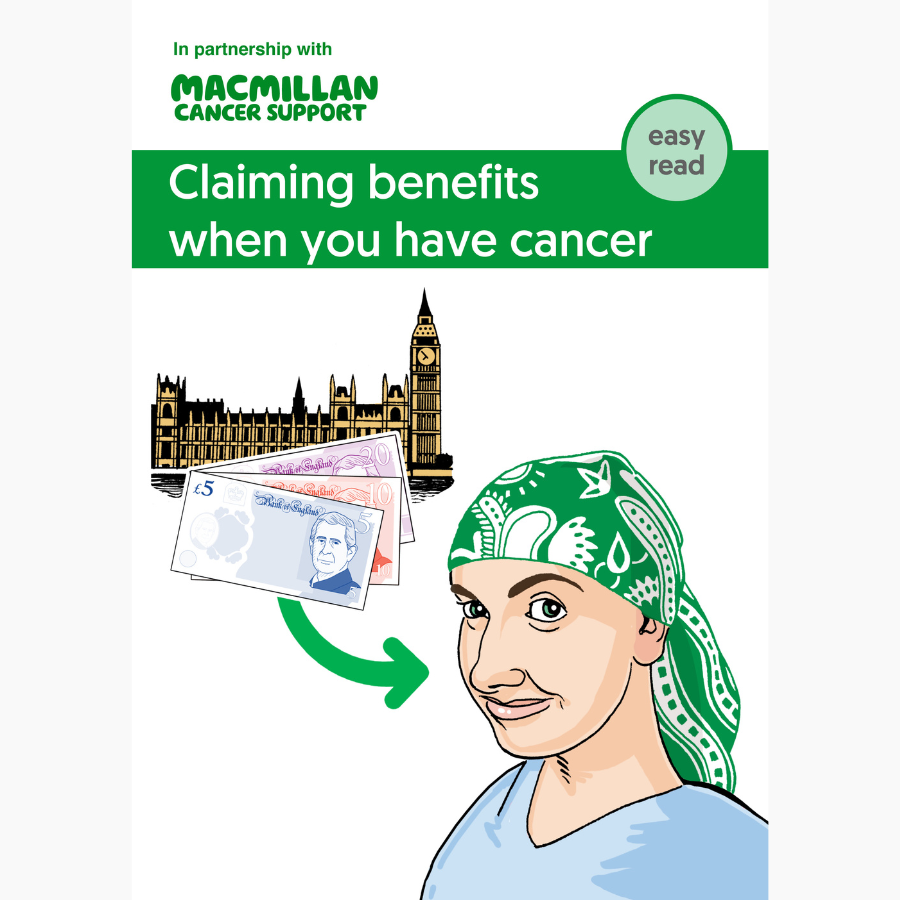
We have information about claiming benefits when you have cancer in other languages.
Or you can call us to talk in your language:
- call free on 0808 808 00 00
- tell us, in English, the language you need.
About our information
This information has been written, revised and edited by Macmillan Cancer Support’s Cancer Information Development team. It has been reviewed by expert medical and health professionals and people living with cancer.
-
References
Below is a sample of the sources used in our benefits information. If you would like more information about the sources we use, please contact us at informationproductionteam@macmillan.org.uk
GOV.UK www.gov.uk [accessed May 2025].
NI Direct www.nidirect.gov.uk [accessed May 2025].
Social Security Scotland www.socialsecurity.gov.scot [accessed May 2025].


Macmillan Welfare Rights Team
Reviewer
Date reviewed


Our cancer information meets the PIF TICK quality mark.
This means it is easy to use, up-to-date and based on the latest evidence. Learn more about how we produce our information.
The language we use
We want everyone affected by cancer to feel our information is written for them.
We want our information to be as clear as possible. To do this, we try to:
- use plain English
- explain medical words
- use short sentences
- use illustrations to explain text
- structure the information clearly
- make sure important points are clear.
We use gender-inclusive language and talk to our readers as ‘you’ so that everyone feels included. Where clinically necessary we use the terms ‘men’ and ‘women’ or ‘male’ and ‘female’. For example, we do so when talking about parts of the body or mentioning statistics or research about who is affected.
You can read more about how we produce our information here.