


What is cancer?
There are over 200 different types of cancer. Each type has its own name and treatment.
About cancer
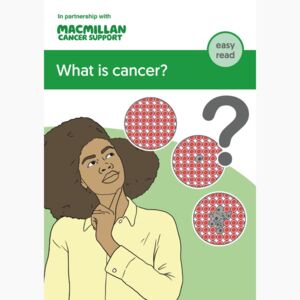
Our bodies are made up of tiny building blocks called cells. Inside every cell is a set of genes. Genes are the instructions the cell needs to work properly.
The instructions send signals to cells to grow and divide and make new cells. This is how our bodies grow and heal.
Sometimes genes in the cell can develop changes. If a gene is changed, it may not give the correct instructions anymore. A change in a gene is called a gene variant or mutation.
Gene variants in a cell may stop the cell working normally. Cancer may develop if cells like this multiply in an abnormal way and grow out of control. Over time, these cells can grow into a lump called a tumour.
This video helps you to understand what cancer is, how cancer starts and how the lymphatic system works.
Read a transcript of the what is cancer video.
The difference between cancer cells and normal cells
Not all tumours are cancer. Doctors can tell if a tumour is cancer by taking a small sample to look for cancer cells. This is called a biopsy.
What is benign cancer?
Tumours that are not cancer are called benign. Benign tumours cannot spread anywhere else in the body. But they can cause problems if they grow and press on nearby organs.
What are malignant tumours?
Tumours that are cancer are called malignant. Malignant tumours can grow into nearby tissue and spread to other parts of the body.
Secondary cancer
Cancer can spread from one place (the primary site) to another through the blood or lymphatic system. When cancer spreads and grows somewhere else, it is called a secondary cancer or metastasis.
Different types of cancer
Cancer can start in any type of cell. This includes tissue or skin cells and cells that form the lining of the organs.
It can also start in stem cells in the bone marrow. Stem cells make blood cells. Cancer that starts in stem cells does not cause a tumour. Instead the stem cells create abnormal blood cells that behave differently from healthy blood cells.
Related pages
Booklets and resources
What is pre cancer?
A pre-cancerous condition is when cells are found to have abnormal changes that may lead to cancer if left untreated.
Having a pre-cancerous or inherited genetic condition does not mean you have cancer. Nor does it mean you will definitely get cancer. But it can increase your risk of developing it.
What causes cancer?
In the UK, about 391,000 people are diagnosed with cancer every year. There are over 200 different types of cancer.
We do not always know the cause of cancer. But some things can increase a person’s risk of getting cancer. These are called risk factors.
We have more information about the causes and risk factors of cancer.
Booklets and resources
About our information
-
Reviewers
This information has been written, revised and edited by Macmillan Cancer Support’s Cancer Information Development team. It has been reviewed by expert medical and health professionals and people living with cancer. It has been approved by members of Macmillan’s Centre of Clinical Expertise.
Our cancer information has been awarded the PIF TICK. Created by the Patient Information Forum, this quality mark shows we meet PIF’s 10 criteria for trustworthy health information.
-
References
Below is a sample of the sources used in our What is cancer? information. If you would like more information about the sources we use, please contact us at cancerinformationteam@macmillan.org.uk
DeVita Vincent T et al. DeVita, Hellman, and Rosenberg's Cancer. Wolters Kluwer, 2018. Available from oncology.lwwhealthlibrary.com/book.aspx?bookid=3236.
Hanahan D. Hallmarks of cancer: New dimensions Cancer Discovery, 2022. 12 (1): 31–46. Available from doi.org/10.1158/2159-8290.CD-21-1059.
The language we use
We want everyone affected by cancer to feel our information is written for them.
We want our information to be as clear as possible. To do this, we try to:
- use plain English
- explain medical words
- use short sentences
- use illustrations to explain text
- structure the information clearly
- make sure important points are clear.
We use gender-inclusive language and talk to our readers as ‘you’ so that everyone feels included. Where clinically necessary we use the terms ‘men’ and ‘women’ or ‘male’ and ‘female’. For example, we do so when talking about parts of the body or mentioning statistics or research about who is affected.
You can read more about how we produce our information here.
Date reviewed


Our cancer information meets the PIF TICK quality mark.
This means it is easy to use, up-to-date and based on the latest evidence. Learn more about how we produce our information.