


Cancer and relationships
If you have a partner
How a cancer diagnosis affects your relationship may depend on:
- how long you have been together
- whether you live with your partner
- how long you have had cancer
- how cancer affects your daily life
- how well you and your partner understand the changes you are going through.
We have information to help you with any practical issues you and your partner may face when preparing for treatment.
Tips for talking to your partner
It can be hard to know how to start a conversation about cancer with your partner. But these tips may help you.
Let your partner know how they can support you
There are different ways your partner can support you. You might want them with you at hospital appointments. This can help you feel supported, and your partner feel valued. They can ask questions too, which can make it easier to talk together afterwards.
Talk openly
A cancer diagnosis affects both you and your partner, so you should both try to talk about how you feel. If one partner feels they always have to be strong for the other, they may begin to feel angry and resentful.
Deal with strong emotions
Strong emotions can often make talking difficult. Often partners try to protect each other by hiding their fears and worries. Talking may help you understand each other and feel closer.
Different ways to communicate
Facial expressions, body language, gestures and tone of voice are all ways to show what we are thinking and feeling. You could also try writing down your feelings and sharing them with your partner.
Look after your relationship
Spend time together and plan fun activities. It is important to keep to your normal routine as much as possible.
Talk about whether cancer is affecting your sex life
Cancer and its treatments can affect your sex life and relationships. But it does not have to mean an end to sex and intimacy. We have more information about the possible effects of cancer on your sex life.
You can also download our Ask for support tool [PDF] to write down your feelings and share these with your partner.
Booklets and resources
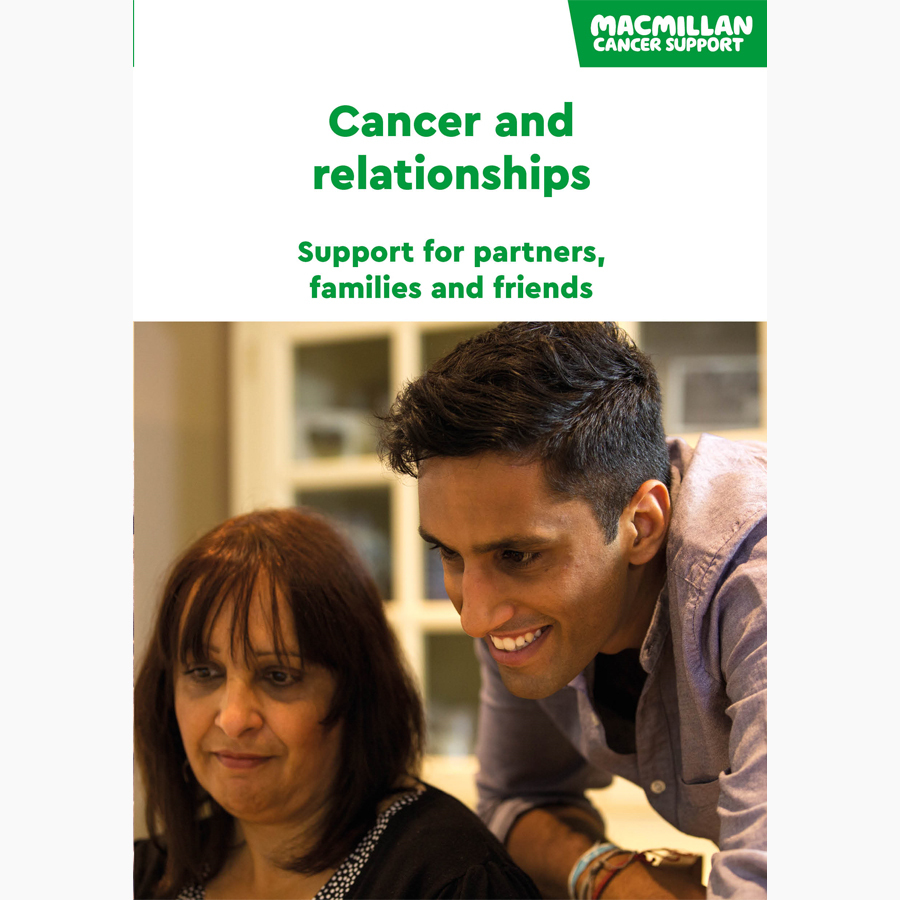

If your partner is your carer
Your partner may also be your carer. A carer is anyone who provides unpaid support to a family member or friend who could not manage without this help. If your partner is your carer, this can also have a big impact on your relationship.
Your partner may find it helpful to read our information about looking after someone with cancer. It has practical tips for carers.
If you are single
If you are single, you may or may not feel like this is the right time to start a new relationship.
If you do want to start a new relationship, it may be hard to decide when to tell a new partner about the cancer. And you may not know how much you want to tell them.
It is best to be open with the other person and make time to talk about your situation.
Getting support
If you think you need some help, you can get support from family or friends. Or you could contact a support organisation such as Relate and Relationships Scotland.
You can also call our cancer support specialists for free on 0808 808 00 00.
Find support outside of your relationship
It may also be helpful for you or your partner to talk to others in a similar situation. You can do this on our Online Community. You may also want to speak to a counsellor or go to a support group, either on your own or with your partner.
Some organisations, such as Relate and Relationships Scotland, offer relationship counselling.
About our information
This information has been written, revised and edited by Macmillan Cancer Support’s Cancer Information Development team. It has been reviewed by expert medical and health professionals and people living with cancer.
-
References
Below is a sample of the sources used in our Talking information. If you would like more information about the sources we use, please contact us at informationproductionteam@macmillan.org.uk
Sharpe L, Curran L, Butow P, Thewes B. Fear of cancer recurrence and death anxiety Psycho‐Oncology. 2018;27:2559–2565. Available from Fear of cancer recurrence and death anxiety - Sharpe - 2018 - Psycho-Oncology - Wiley Online Library [accessed February 2023]
Zeng Q, Ling D, Chen W, et al. Family Caregivers’ Experiences of Caring for Patients with Head and Neck Cancer. A systematic Review and Metasynthesis of Qualitative Studies. Cancer Nursing 2023; 46,1, 14-28. Available from Family Caregivers’ Experiences of Caring for Patients With Head and Neck Cancer - PMC (nih.gov) [accessed February 2023]


Date reviewed


Our cancer information meets the PIF TICK quality mark.
This means it is easy to use, up-to-date and based on the latest evidence. Learn more about how we produce our information.
The language we use
We want everyone affected by cancer to feel our information is written for them.
We want our information to be as clear as possible. To do this, we try to:
- use plain English
- explain medical words
- use short sentences
- use illustrations to explain text
- structure the information clearly
- make sure important points are clear.
We use gender-inclusive language and talk to our readers as ‘you’ so that everyone feels included. Where clinically necessary we use the terms ‘men’ and ‘women’ or ‘male’ and ‘female’. For example, we do so when talking about parts of the body or mentioning statistics or research about who is affected.
You can read more about how we produce our information here.