


Help with making treatment decisions
Decisions about treatment
When you have decisions to make, it is often useful to write things down. This can help you to think about all the different parts of your situation.
One useful technique is to write a list of the benefits and disadvantages of the treatment or treatments you have been offered.
Try to think about:
- the aim of the treatment
- how successful the treatment is likely to be
- the possible side effects
- how often you will need to go to the hospital and for how long
- the effects of the treatment on your family and social life
- the effects on your work and finances
- what happens if you do not have a particular treatment.
Other useful things to ask yourself:
- Who do you have around you to help practically and help you cope emotionally?
- How have you made sometimes difficult decisions in the past?
- What are the things you value in life and how might you stay connected with these even during treatment? For example, if work is important to you how can you keep in touch with colleagues?
You can make an appointment with your cancer doctor or specialist nurse to discuss this with them. You do not have to make a decision on your own. You and your cancer doctor can decide together.
Talking to family and friends may also help.
Benefits and risks of treatment
Your doctor can help you to understand the possible benefits and risks of different treatments. This can help you make the right decision for you.
We have more information explaining benefits and risks.
Statistics
Your cancer doctor will prescribe a treatment because they believe that its benefits will outweigh any side effects. They may use statistics to tell you what they know about a treatment. Statistics are a way of presenting information using numbers. They are based on large numbers of people.
They cannot tell you exactly what is going to happen to you. But they can give you an idea of how likely each outcome is.
You might find some statistics helpful when making treatment decisions.
Related pages
Other people who can help you decide
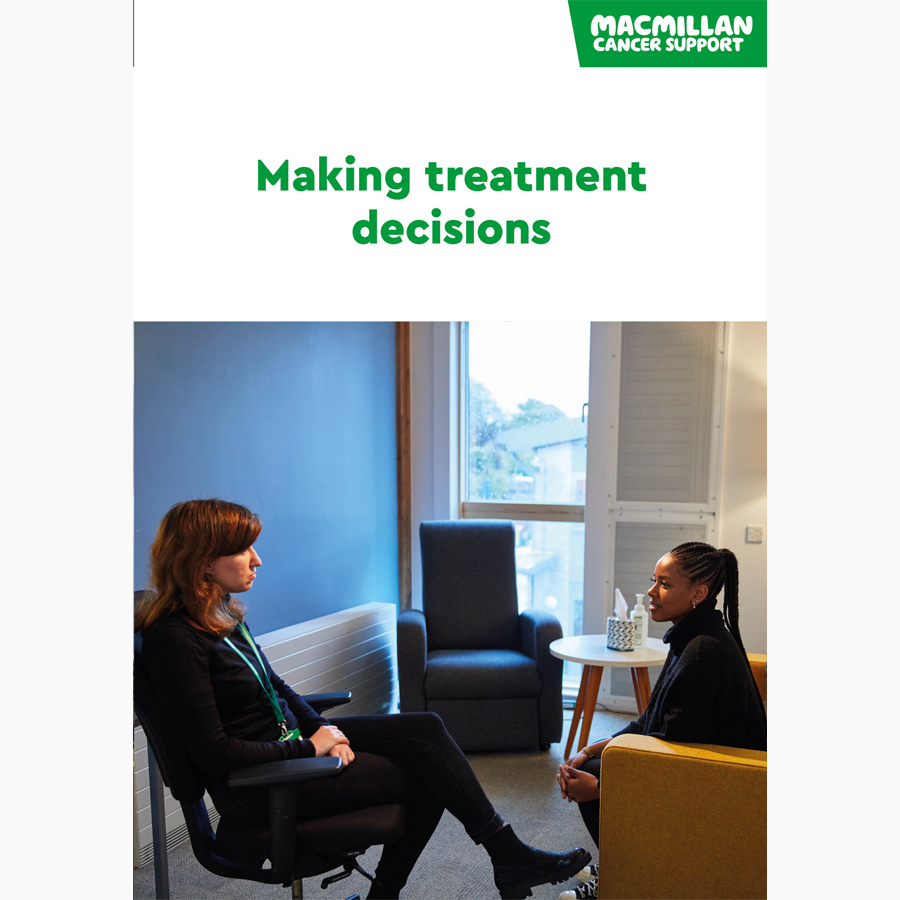
Before you make a decision, talking to someone can help you with your thoughts and feelings. You will usually have a specialist nurse at the hospital you can talk to. You can also talk things over with your GP.
If you have any doubts about any of the information you have, always check with your healthcare team.
A psychologist or counsellor may support you to make decisions about:
- intensive treatments
- treatments that change your appearance or how your body works.
- Your cancer doctor or specialist nurse can usually arrange this.
Healthcare professionals are not the only people who can help you. You might have family or friends to talk things through with. Sometimes a support group or organisation, or an online forum, such as our Online Community, can be helpful.
You can also call the Macmillan Support Line for free on 0808 808 00 00, 8am to 8pm, 7 days a week. If you prefer to speak to us in another language, interpreters are available. Just state, in English, the language you want to use when you call.
Everyone is different. The right choice for someone else may not be best for you.
We have more information about getting help with your emotions.
Booklets and resources
If you do not want treatment
Tools to help you to make decisions
Your cancer team may be able to suggest a decision aid to guide you through your choices.
There are different tools to support people making treatment decisions. They can help you to get the information you need and think about what is important to you.
Some tools include questions to ask your doctor or nurse to help you make better decisions together.
Ask 3 questions
- What are my options?
- What are the benefits and disadvantages of each option for me?
- How do I get support to help me make a decision that is right for me?
BRAN
This asks the following 4 questions:
- B - What are the benefits?
- R - What are the risks?
- A - What are the alternatives?
- N - What if I do nothing?
PREDICT tools
Certain cancers have specific patient decision-making tools. They help you to understand how well different treatments have worked for people with the same type and stage of cancer.
Your healthcare team can tell you more about these. These tools are regularly updated and based on the best current evidence.
Some examples of patient decision-making tools are:
- PREDICT Breast – if you have had surgery for early invasive breast cancer and are deciding which other treatments to have.
- PREDICT Prostate – if the cancer is contained in the prostate and you are deciding on what type of treatment to have.
My information table
Your feelings about your decision
When making treatment decisions, there is not always a clear right or wrong answer. Your cancer doctor may not be able to say for sure whether a treatment will work, or how it may affect you.
Uncertainty can be hard to deal with. It sometimes gets easier as time passes. Talking to family, friends and healthcare professionals about how you feel can usually help.
Some people find it useful to talk to a counsellor or psychologist. Your local cancer information centre or support group may have a counsellor you can talk to. Or your healthcare team might be able to refer you to a psychologist or counsellor.
You may feel overwhelmed by all the information you have been given. Or you may feel under pressure to do what you think your family and friends want. It may help to think about how you have approached big decisions in the past:
- Are you guided by your first impressions and instincts?
- Do you usually need to think things through for a long time?
- Do you make decisions alone, or after talking through your options with family or friends?
If you can, taking a short break may help. You can then look at all the information together. If you need to decide quickly, it may help to get a good night’s sleep and make your decision the next day.
How do you know it is the right choice?
There is no right or wrong decision. People make different choices for different reasons. Your decision is the right one for you at the time you make it.
Doctors only usually offer a choice of treatments if they work equally well.
You may be able to change your mind about a treatment. If your situation changes, your choices may be different. Your healthcare team will always support you and respect the choices you make.
About our information
-
References
Below is a sample of the sources used in our Making treatment decisions information. If you would like more information about the sources we use, please contact us at cancerinformationteam@macmillan.org.uk
National Institute for Health and Care Excellence. Shared decision making. NICE; 2021. NICE guideline [NG197]. Available from: www.nice.org.uk/guidance/ng19. Last accessed January 2023.
Hayter C, Andrewes T et al. Factors affecting patients’ decision-making about treatment for cancer: a literature review. Cancer Nursing Practice. 2021; doi: 10.7748/cnp.2021. e1769. Last accessed January 2023.
-
This information has been written, revised and edited by Macmillan Cancer Support’s Cancer Information Development team. It has been approved by members of Macmillan’s Centre of Clinical Expertise.
Our cancer information has been awarded the PIF TICK. Created by the Patient Information Forum, this quality mark shows we meet PIF’s 10 criteria for trustworthy health information.
The language we use
We want everyone affected by cancer to feel our information is written for them.
We want our information to be as clear as possible. To do this, we try to:
- use plain English
- explain medical words
- use short sentences
- use illustrations to explain text
- structure the information clearly
- make sure important points are clear.
We use gender-inclusive language and talk to our readers as ‘you’ so that everyone feels included. Where clinically necessary we use the terms ‘men’ and ‘women’ or ‘male’ and ‘female’. For example, we do so when talking about parts of the body or mentioning statistics or research about who is affected.
You can read more about how we produce our information here.
Date reviewed
Our cancer information meets the PIF TICK quality mark.
This means it is easy to use, up-to-date and based on the latest evidence. Learn more about how we produce our information.