
Browser does not support script.
Skip to main content
search here
Between April 2010 and July 2012, the National Cancer Survivorship Initiative| (NCSI) undertook an extensive pilot project to examine how work support for people with cancer could be improved.
Seven pilot sites across England were funded to develop services to help people with cancer remain in or return to work. The overarching finding of the NCSI project is that the impact of cancer on a person’s employment should be discussed from the time of diagnosis, and remain a topic of discussion throughout the treatment pathway and on into life beyond cancer – or end-of-life care, where that is appropriate. It should not be an add-on service, offered only when problems arise.
Health and social care professionals have a vital contribution to make. The five ‘Rs’ summarise the role of doctors, nurses, allied health professionals, social workers, cancer information specialists and other staff with whom the patient comes into contact.
It's important to provide early and ongoing support, but this is not straightforward; it's often only in retrospect that patients recognise problems. And professionals are understandably cautious about raising work issues around the time of diagnosis, not wanting to seem inappropriate and insensitive. Patients suggest that asking a question like, ’What things in your life are affected by your diagnosis and how can we help you with these?’ is likely to elicit more useful information than, ’Is work a problem?’.
Professionals then need to look out for risk factors, for example, has the person made contact with their employer? Is the person self-employed? How flexible is the job?
It's not necessary for professionals to become experts in vocational rehabilitation and employment law. But it is necessary for them to understand that meaningful work is an important component of people’s well-being, and that they should do all they can to enable patients to think positively about work.
Further information
The NCSI’s final evaluation report, Thinking positively about work, is available from the NCSI website|. You can also email Dr Gail Eva|.
Dr Anne Lee, Macmillan Consultant Clinical Psychologist
Often work concerns arise toward the end of treatment, when people want to return to work and to normality. A main worry for people is the physical and psychological impact of cancer and its treatment. For example, how fatigue| and low confidence may prevent them from doing their job.
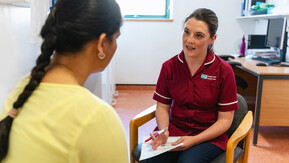
We support people by talking things through and providing practical support. For example, we help to get structure back in their day or practise difficult conversations. I often suggest that people meet with colleagues before they officially return to work to gain more confidence. If a person has had a return to work that hasn’t gone well, we explore a way forward. Sometimes I contact the employer’s HR department or send a report on the patient’s behalf. I've found that small companies, which haven’t had a lot of experience with cancer really appreciate this.
My advice to healthcare professionals is to explore the situation sensitively from an early stage to prevent problems later on.
Work is an important part of life for many people, as it can give a sense of purpose and social inclusion. I am interested in how cancer impacts on a person's life as a whole, so that is what we explore.
Debbie Smith, Macmillan Information and Support Centre Manager
At the Macmillan Cancer Information and Support Centre in Wythenshawe Hospital, we see people of working age on a daily basis.
When people talk to us about work, they can be concerned about losing their job, income, skills, friends and support, confidence, status and fringe benefits. They may also have concerns about returning to work as they may not be able to carry out the same role because of physical and psychological difficulties. For others, it may initiate a whole different outlook and they are relieved to give up work or change roles.
Once concerns are voiced, people are so relieved that we can support them and are often surprised that this is part of Macmillan's service offers. We go at the person’s pace and always allow for a follow-up session as some cases may be quite complex.
We tend to look at trigger points in the patient care pathway as we do with benefits advice. We are also fortunate to have access to a specialist Macmillan/Shaw Trust job adviser. We have created a Friday morning ‘drop in’ within the centre. We not only support individuals, but we inform and raise awareness of cancer in the workplace with local businesses and employers.
You don't have to be an expert to talk about work. This bite size e-learning course can give you a better understanding of the issues people affected by cancer can face in the workplace. Access the course for free at Learn Zone|. We also have the Working with cancer course, which covers the occupational impact of a cancer diagnosis on working age adults.
This is a practical tool to support professionals to have a conversation about work. It suggests questions to ask and provides signposting information to give to your patients. To download the guide and for more information and videos about work and cancer, see our section on Work and cancer|.
More from the latest edition of Mac Voice|
Macmillan Learn Zone|
Macmillan Online Community|
Writing an article for Mac Voice? Download top tips|
Tel 020 7091 2219
Email macvoice@macmillan.org.uk|